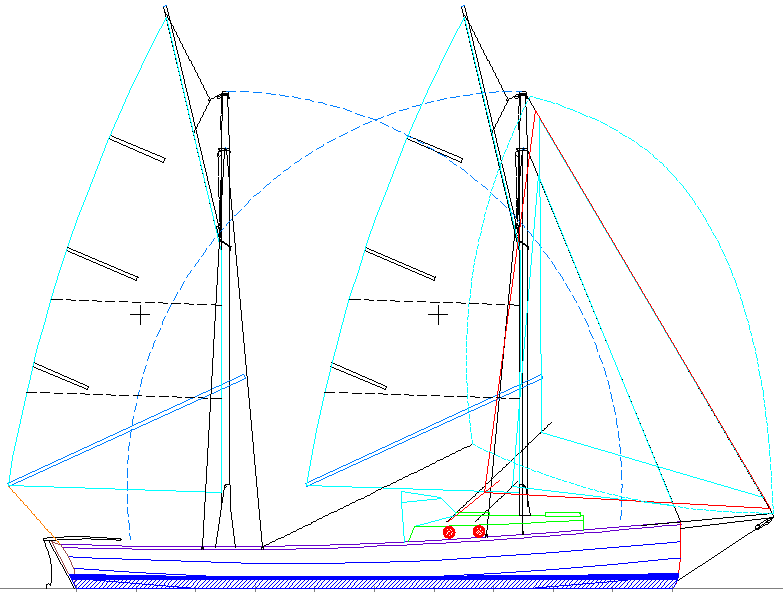
I am working on an interesting commission, have been for a few months and it is nearing the end of the design work. The boat is being built in Gibsons on the gorgeous Sunshine Coast in British Columbia, Canada. This is the first metal design commission that I have had in a long time, with metal boatbuilding being in somewhat of an hiatus for a few years. That part of the world has a massive logging industry, with logs floated downstream in the rivers in huge rafts. Logs are like cattle being herded to market by cowboys; occasionally one or two get away from the herd.
In the case of wayward logs, they can drift around for a long time before going ashore on a beach, where they become handy seats on which to picnic with the family. Until they are washed ashore they are navigation hazards for boats, particularly when they become deadheads i.e. floating vertically. In that position they present very little above the water to be spotted from a boat but they have tremendous inertia, capable of doing substantial damage to a boat that collides with them. It is no surprise then, that aluminium boats are more popular in logging waters than elsewhere. They have more chance of bouncing off the log with no more than a dent that could fracture a fibreglass or wooden hull.
 |
| Owner Tom McPherson with his aluminium hull |
This new boat was commissioned by Tom McPherson for adventure cruises in the protected waters between the mainland and Vancouver Island. Although these cruising waters are protected from Pacific Ocean swells by the 285 mile long island, the channels and fjords are well-known for strong currents and eddies. Thick fog is also very common, so careful navigation and attention to obstructions and depths is necessary to stay safe.
The intended customers for the adventure cruises will be teenagers, learning about the wilderness through which they will be moving, the creatures that inhabit it both on land and in the water, and the flora of the dense forests. Man is doing so much to mess up the beautiful blue marble on which we hurtle through space, so teaching the next generation about stewardship of the wilds and our fragile world is an important issue.
This is not just a holiday cruise for the young crew; they will learn the skills of boating and earn their way with aching limbs and calloused or blistered hands. With only a small outboard motor for propulsion into and out of harbour the crew will sail her some of the time and row her at other times. She has thwarts for 8 rowing positions. This is no luxury cruise, the crew will sleep in the large cockpit under the stars or a cockpit tent when needed. There is a small cabin in the bows, with a pair of V-berths, galley and enclosed heads.
For stability and windward ability, she has a ballasted swing keel. The cockpit has a long covered channel full-length, draining through the keel casing and outboard engine well.
This boat has to be able to carry a relatively large live load of 10 teenagers plus two adult crew, in addition to stores (which can be replenished as needed by occasional stops along the way). There is a benefit derived from the live load, of course, of considerable portable ballast that can be moved around the boat for best trim and stability.
With the intended use of gliding along with minimal disturbance among and past the wild animals of this wilderness, a boat of easy lines was needed, one that creates minimal waves and is very easily-driven under oar power. For sailing, she has a gaff schooner rig that can carry a reasonable spread of canvas with a low centre of effort, very versatile in a range of sail combinations to optimise area and helm balance to suit wind conditions. The spars are sealed carbon tubes in tabernacles, easy to raise and lower. The boat is legal towing width for transport on land, so the masts can be folded down horizontal and left in their tabernacles to simplify the process.
 |
| Gaff schooner rig, carbon tube masts folding down on tabernacles. |
The hull is a big sister to my Cape series of designs that started with the
Cape Cutter 19 and has spread over the years up to 32ft. But those are beamy boats and this one has been stretched out to give the slim and easily driven hull needed for her intended use. It results in a boat of very graceful lines and proportions, with fine, hollow bow at waterline and clean stern. She will slip through the water easily under sail or oars.
 |
| Slim, sleek, easily-driven hull with fine bow and clean stern. |
Yes, the Cape designs all have lapstrake plywood hulls. This new boat (we really must give the design a name) has the lapstrake shape but done in aluminium. To get that right, I was pleased to be working with an experienced builder with whom to figure the best way to get the shape needed, without distorting the hull plating from excessive welding. John Dearden is that builder, having built the aluminium centre cockpit
Dix 43 "Namo" as a custom build for her owners about a decade ago.
Owner Tom is working with
John Dearden on the build. They turned the hull over a few days ago and report that it has turned out fair and is very pretty. Planned to be in service in the coming season, the launch is targeted for March.
 |
| Turning the hull happened a few days ago. |
Tom McPherson shows the project and his cruising grounds on Instagram at
Seaforth Expeditions. He has photos and time-lapse videos of the turn-over and videos of his cruising grounds.