Showing posts with label Cape to Rio Race. Show all posts

Wednesday, February 1, 2017

Black Cat Report from Rio

Didi 38 "Black Cat" arrived in Rio de Janeiro on 21st January in great style but with a very dead motor. One of the two cylinders had blown its head gasket a few days earlier. The motor was needed to charge batteries for the electrical needs of lighting, communication, instrumentation, navigation, watermaker etc., so they made some modifications to allow it to run on the remaining good cylinder. That eventually also gave in, so they received a tow from the finish line to the yacht club. A local mechanic has been assisting them to repair the motor.

Dave has given really good reports about their treatment at Iate Clube do Rio de Janeiro this year. That is good news for us yotties because the club members have been somewhat less than welcoming at the end of past races. This time crews have had full access to all parts of the club, whereas we were not permitted inside the clubhouse before. I had been lucky enough to have had meals in the excellent club restaurant in previous years because I was on the race committee, so had better than average privileges. Dave says that they have been very helpful with sorting out the engine problems as well.
Iate Clube do Rio de Janeiro
Most of the above came from Dave in a phone call. Here is his report received by email yesterday.
 
"Hi All

Just a quick update to let you all know what is happening here in Rio. We are still waiting on the mechanic, who yesterday, put the whole motor back together with newly done valves to gasket etc. We attempted to start and still no compression in cylinder no 2... After much discussion we stripped the whole motor out and are now looking at rings and pistons. Basically a major rebuild. So we wait again until Friday or Saturday. Not a problem just a bit frustrating. We did want to go to the Islands south of Rio, however that is now out of the plans. So we, with any luck, will be heading home on Saturday morning.

Rio and the yacht club here has been more than welcoming and a good time is being had by all.

Will send another update when things develop.

Cheers
Wavy"

Plans have changed since Dave wrote that report. With the motor out of the boat and being rebuilt in the mechanic's workshop, they decided to sail to the Bay of Islands for a few days of relaxed cruising before returning to Rio for the motor to go in again ahead of the voyage back home. They should be anchored somewhere around the idyllic Isla Grande right now.
I took this photo at my favourite spot in the Bay of Islands, Saco do Cue, in 1996. The little girl in the rubber duckie is my daughter, 8 years old at the time.
I will update when I have more info about their plans to depart Rio for Cape Town.

Friday, January 20, 2017

Finishing the Cape to Rio Race

Approaching the finish line of the Cape to Rio Race presents some interesting choices that must be made on all boats. Some choices are because of the wind conditions generated by the topography of the land close by and some are because of timing of the approach.

I have completed this race three times, in 1993, 1996 and 2000. Those races were all a bit different from this one in that we had the island of Trinidade as a mark of the course, to be left to port. This island is about 600 nautical miles east of the Brazilian mainland and having to go around it forced all boats to approach the finish from the northeast, with Cabo Frio as landfall and an obstacle that must be rounded. From there to Rio there are areas of fluky winds that have to be negotiated.

Trinidade is no longer a mark of the course, so the boats cut the corner and mostly approach from a more easterly direction. Whereas in the past we sailed close by Cabo Frio, this time many will only have seen Cabo Frio on the horizon. Now few are getting themselves trapped in the windless waters around the islands 25 miles from the finish, instead staying further out to sea in cleaner breeze.

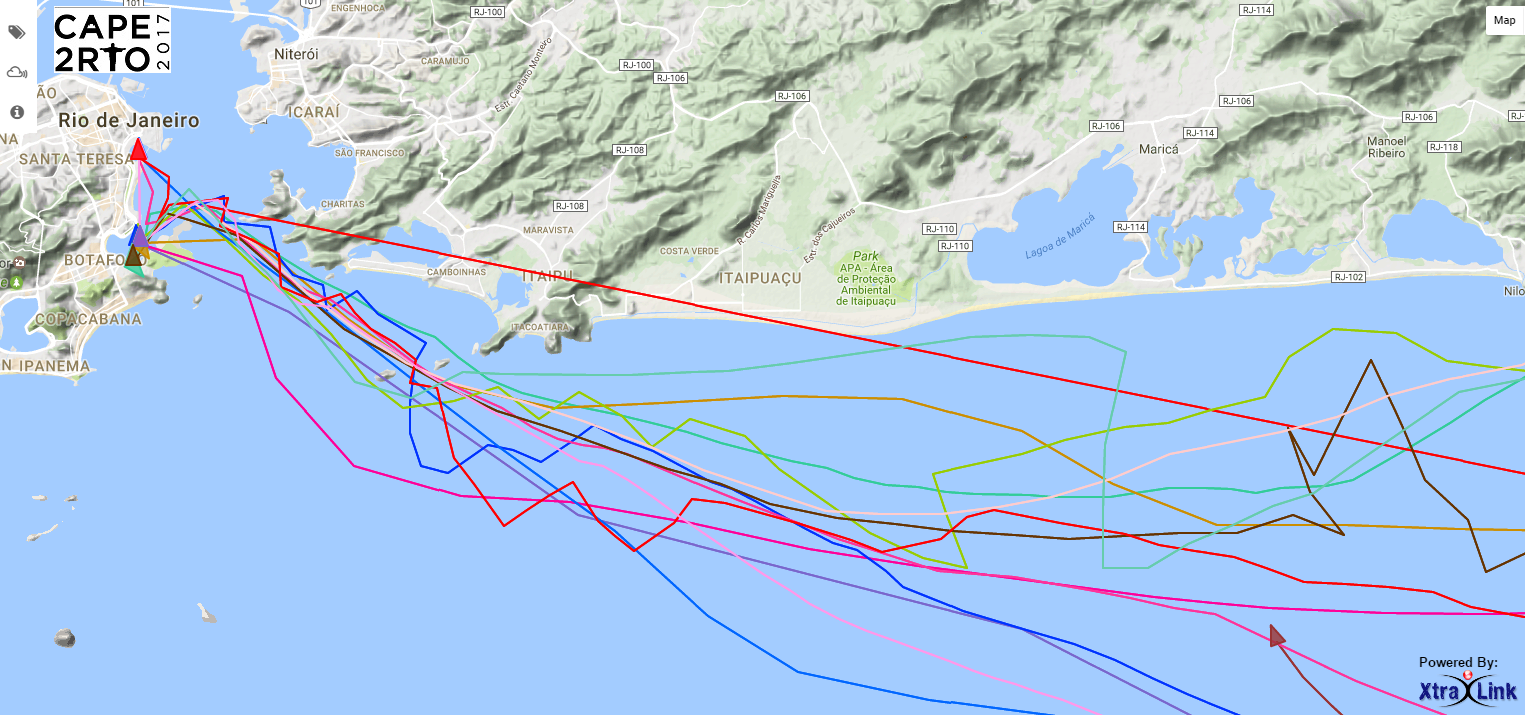
The other difference from the races that I have sailed is that the finish line has been moved for some reason that is not known to me. Refer to the image below for a comparison between the two finish lines. This is an image from the tracking map today, December 20th. It shows the tracks of all boats that have finished the race.
Tracking map of the approaches to the finish line. Click on the image to enlarge. Image courtesy of Xtra-Track.
The landward end of the finish line in the past has been at an historic military fort on Ipanema point, under the 2nd "A" in "Ipanema" on the map. The other end of the line was on one of the islands south of that point, out in open water. It gave a long line without excessive current and well clear of the mountains that so affect wind strength and direction. We were able to choose where we wanted to cross that line, depending on wind and current conditions.

Now the finish line is also run from an historic military fort but it is on a tiny island right in the mouth of Guanabara Bay, with a short line defined by the island and a buoy. The line is right in the area of strongest current, with massive volumes of water rushing into this very large bay and back out again six hours later, twice in each 24 hours. Add to that the proximity of this finish line to the famous Sugarloaf mountain that guards the western side of the entrance and we find that the winds may be light to non-existent in this area. Any boat that is unlucky enough to arrive on an ebbing tide may find that they don't have the breeze needed to fight against the strong current, while another boat might have arrived 6 hours earlier or later and found that the flooding tide carried them very speedily down the middle of the channel and across the finish line.

In the map image above you can judge quite well which boats arrived on a flooding tide or slack water and which ones arrived on an ebbing tide. These tracks are not a continuous record of the path that a boat sailed, they are updated at 30-60 minute intervals, so the lines link the spots that each boat was at the times that the tracking system communicated with their tracking transponder. You can see which boats had an easy passage and which had to fight all the way to the line, tacking through the moving water and looking for the areas of least contrary current.

The fortune or misfortune attached to the time of arrival can make a difference of hours to the finishing time, with some boats rushing through the bay entrance and finish line in less than 30 minutes and others taking hours to negotiate the same short distance. Two boats can fight fairly against each other all the way across the ocean, separated by hours on the water but nose-to-nose on handicap. Then they reach the mouth of Guanabara Bay and one has a flooding tide and the other arrives on the next ebbing tide, which cancels out all of the good racing of the previous 2-3 weeks.

We can deal with the vagaries of wind speed and direction, that is part of yacht racing. However, I don't understand why the organisers would add the much more damaging potential of strong currents into the final few miles of a 3500 mile trans-ocean yacht race when there appears to be a perfectly acceptable alternative just a few miles away. It is such an illogical choice that I have to think that there is some reason that I don't know. If the reason is a matter of convenience for those who crew the finish line, that really is not good enough. This race attracts many boats, crewed by hundreds of people and costing millions of dollars in total outlay for the race. Everything possible should be done to make the race as fair as possible for every boat that jumps through the many bureaucratic hoops and negotiates the financial obstacles that are always involved in an international race of this stature. Nobody can do anything about boats of such varying speeds sailing in different weather systems along the course but the start and finish are very visible aspects that contribute to the overall feel of the race and the level of satisfaction of the people involved. Moving that finish line to a less contentious position will help elevate the satisfaction level for those who participate in competing across this massive piece of water.


Wednesday, January 18, 2017

"Black Cat" Rio Race Report #5

Since the last report from skipper Dave "Wavy" Immelman on the Didi 38 "Black Cat", I have looked at their track on the Xtra-Track map for the Cape to Rio Race and wondered why they are sailing such wide angles, sailing reaching courses that seem to be way higher than optimal VMG courses and are giving away many miles against the competition. In the process they have dropped one position, from 3rd to 4th in their division. I planned to write about it today but have just received the report below from Wavy, which answers the question.
Tracking map of this morning. The track of "Black Cat" is the purple one running diagonally from top right to centre bottom, in the process covering enough ocean to go from the most northerly position in the fleet to the most southerly position. Click on the image for a larger view. Image courtesy of Xtra-Track.
Hi All,

Well we are in the home stretch now and aiming straight for Rio, 525 nautical miles to go. So, with any luck some time on Friday evening we should make landfall. Then there is the issue of getting to the finish line through the light airs behind the mountains.

We have had another eventful few days. Will it ever end and just some plain sailing please.

The second half of our already halved motor has now blown up. So we now have a 0 cylinder 0 HP motor.  At least this time when she blew the oil was contained in the engine compartment and not all over the saloon and me. No watermaker, freezer, fridge or music. We do have enough water to make it in without an issue and the food we have should last. Tiffany at the race office has been brilliant and has arranged a tow-in to the new marina. She has also arranged for a diesel Mac to come down and expedite repairs before our trip back to Cape Town.

To add insult to an already salty injury, we broached out yesterday morning and snapped the spinnaker pole against the forestay. This means that we are down to two sails, the A3 currently flying and the  already repaired A0. I have glasses up the pole and it might hold for a while, but it certainly won't take too much weight. Well another repair on the list before the trip home.

The on board spirits are still high through all the hardships. To give an example, the guys are realising that if one crew is tired and they are not, with no thought for themselves, they step in and do an extra hour or two of watch, allowing the rest to sleep. They make jokes in the cockpit all the time and the banter about cold beer... No let me rephrase that... Anything cold, well you can imagine.

With the increased air temperature the daily bath off the back is a god-send and  a wonderful time to cool off, even if the sea temperature is 28.5°C. If fact I don't think that anyone has even looked at their sleeping bag for the last week. And night watches are done in shorts and a PFD. In fact the last two sail changes and bits of pole recovery were done in jocks and PFD. Cool sailing kit!

Talking of nights, we had the most beautiful moon rainbow. Rain east of us and the bright moon and a night time rainbow. Quite incredible. Later that night the International Space Station came over like a spotlight in the night sky. Makes use feel a little slow as they go around the world in 26 minutes and it would take us about 26 months.

Well the weather forecast for the next few days is promising, so let's hope for a lovely last few days at sea."


We at Dudley Dix Yacht Design wish "Black Cat" and crew better fortune and good sailing for the last few days of the race.

Sunday, January 15, 2017

"Black Cat" Rio Race Report #4

The two fastest boats have finished the race in Rio and the rest of the fleet continues to race as hard as before. The Didi 38 "Black Cat" and her closest rivals are now well into the last 1/3 of the race and anticipating their arrival in Rio.

For those who don't know how ocean racing works, each of these boats has a rating, an evaluation of the theoretical performance of that boat relative to all others in the fleet. So all boats race against the clock and against each other through that clock. The catamarans are racing against the other catamarans on a multihull rating system and the monohulls are racing against each other on a monohull rating system. Complicated formulae that have been developed over many years are the basis of these rating systems.

I have the next report from Dave Immelman, skipper of "Black Cat".

Hi All,

Well, we are under a 1000 miles to go. A few tricky patches to get through in the next few days on our final leap to Rio and the good times!

We have had an eventful few days with the weather and with the boat.

On board we had a little motor disaster as the no 2 cylinder blew it's cylinder head gasket. Not what you really want 1500 miles from the nearest diesel Mac. Time to make a plan and get it running again as it charges our batteries. (We do have a solar panel which has kept us going but not to the point we can run fridge, freezer and water maker.) We started to have compression problems as well as starting issues. This led to diesel in the sump and, worse, exhaust into the sump, building pressure. The motor was running but started to sound bad so, upon checking the sump, pressure was so high it shot the dipstick out and sprayed diesel/oil mix all over the cabin. So, after many hours of jury rigging, we have now converted our 20 HP two cylinder motor to a 10 HP single cylinder. Purring like a dream and charging to our full requirements. In fact it took us as long to clean the mess as to fix the motor. The only thing is we might not have enough HP to drive the boat forward, but that is a post finish problem.

We have also started to be hit by the odd rain squalls. Fun and games. Surfing and broaching. Loads of fresh water, so all on deck in swimming costumes and PFD's enjoying the fresh water shower. Yesterday we were in a particularly heavy storm, so we collected a bucket full of fresh water and had extra water for coffee and tea all night, without digging into our daily ration. Nice!

The crew are all well and enjoying the sailing. In fact it has come to the point where the daily routine/systems are just running themselves. Things just happen. Brilliant.

Most afternoons we sit up on deck with the watch, listening to music and chewing the fat. Especially when yesterday we saw our first competition since we passed the Indian Navy weeks ago. Well guess who, The Indian Navy. It is all well and good knowing where the guys are, but it is really nice to see one.

Well, knowing we have company, I will sign off now and chat soon.

Cheers

Black Cat"

The reference to "the Indian Navy" is not to a warship but to the yacht "INSV Mhadei", which belongs to the Indian Navy and is crewed by Indian naval personnel

We wish "Black Cat" and her crew continued good sailing and a happy ship.

Dudley Dix Yacht Design 

Friday, January 13, 2017

Match Racing in Mid-Atlantic

The Cape to Rio Race boats are into the 2nd half of their race across the South Atlantic. The faster boats from the 2nd start are easily-drive and very powerful boats, able to sail fast in light winds. They have passed to the south of the more cruising-oriented boats that started in the first start, six days before the main start. Now the bulk of the 2nd start fleet is overtaking those slower boats.

The Didi 38 "Black Cat" is in a group of five boats that has been sailing in fairly close proximity to each other for quite a few days. "Close proximity" is a relative concept, of course. These boats look very close to each other when seen on the tracking map but, on the wide blue South Atlantic Ocean, in reality they are likely not even seeing each other on the horizon except briefly if their courses cross.

"Black Cat" (purple) has been crossing paths with the Stadt 65 "INSV Mhadei" (green) ever since the start of the race, they can't seem to break away from each other for long without coming back for their next meeting. The other three boats in this group are the Beneteau First 447 "Ray of Light" (brown), the Fast 42 "Blue Label Telecoms" (grey) and the Beneteau First 40 CR "First 40" (mauve). The colours all refer to the arrows and tracks shown on the tracking map image below. The other tracks and arrows are mostly boats that were in the first start. Seen in a zoomed-out view of the map it looks almost as though these boats are match racing each other in mid-Atlantic. In reality each boat is gybing downwind to get the best angles for fastest VMG (Velocity Made Good) toward the finish line in Rio. The best angle for each boat depends on the sails that they have available onboard but all are following similar courses and tactics.
Tracking map courtesy of Xtra-Track. Click on the image to enlarge it.
Having sailed this race a few times myself, I know from experience that boats that look close by on a tracking map or plotted on a chart will be far over the horizon and can't be seen from deck level. I have on many occasions gone to the top of the mast in a bosun's chair to look for those boats that are so close but can't be seen.

From deck level you are alone on a big flat piece of blue water. From the top of the mast you can see so much further and the other boats may appear as dots on a much broader horizon. The big flat piece of water grows bigger the higher you go and becomes a massive upside-down bowl, curved all round, with your boat right in the geometric centre of it all. You are at the centre of your own private world, for once in your life. It brings a totally different perspective to sailing out into the wide blue yonder.

It can bring a sense of euphoria, a feeling of wanting this to never end. You feel that you are alone in the world and life is wonderful, that you really don't care a damn about the problems that are troubling the world, who has or hasn't won whatever election, what is happening to your investments in Wall Street, who is making war with whom or other worries of day-to-day living on land. Yet, at the same time, you also yearn for loved ones, for the personal contact with family and friends who are not out there on the boat to enjoy what you are loving so much.

I hope to have another report from "Black Cat" in the next day or so, maybe some photos also.

Tuesday, January 10, 2017

"Black Cat" Rio Race Report #3

Report # 3 from Dave "Wavy" Immelman, skipper of the Didi 38 "Black Cat", racing across the South Atlantic from Cape Town to Rio de Janeiro.

"We are fast approaching the half way. It has been a very eventful first half, so with any luck we have been through the hard times and are now heading for some lovely plain sailing. Ha ha fat chance this is the Atlantic Ocean. So we deal with what will come.

We are currently sitting on starboard gybe doing about 8 knots in 13 knots of wind with a small following sea under the light of a full moon. Sitting in shorts and PFD's. Does not get better than this!

The Black Cat sail repair team has been hard at work and the A0 is back in the sail locker and working. The S2 is also almost done. Eat your heart out North Sails.....Sorry Joe but there is plenty of work for you when we get back.

The guys and girl have all settled into the normal rigors of sea life. Broken sleep patterns, odd work hours.... The wind never seems to shift when everyone is on deck and ready but instead just as the off watch have just gone to sleep. How inconsiderate. But to a man they still get up and do their jobs.

It is very hot out here, in fact it seems hotter than normal but that might be me just getting older. It has however not stopped Josh and Shane doing their daily exercises. The joy of being young and full of energy.

The bath on the sugar scoop is a daily favourite. And it is a chance to cool off. For those who don't know, we put a harness on and step over the back onto the aft platform. There the water rushes in and out so one can bath and rinse in the Atlantic without having to stop and swim. We also have a frying pan tied to a lanyard for the odd shampoo.

Otherwise the crew are all well, if not well rested. The laughter is still thick and fast. The food is good, and the general mood is upbeat.

Cheers to all at home and keep in touch.


Black Cat crew."

Seems that they are enjoying themselves. We at Dudley Dix Yacht Design wish them happy sailing.

Friday, January 6, 2017

"Black Cat" Rio Race Report #2

Here in Virginia Beach we are under a blizzard watch for the next 24 hours, with possibly a foot of snow expected. Meanwhile, in the middle of the South Atlantic they are in mid-summer and hot. I was supposed to be there, not freezing my butt off in these temperatures and fixing my generator in preparation for potential power outages in the snow, ice and gales. Well, that is the way that it is and it does give me another 2 months to catch up on my work backlog.

Here is the second report from skipper Dave Immelman on the Didi 38 "Black Cat".

"Hi Everyone,

News from Black Cat.

Well, our first update from our trans-Atlantic Race is both good and bad. The great is that all on board are  well and in high spirits. We have all settled in to little sleep, sore fingers and squinting eyes, eating on the go and grabbing a quick 40 winks when we get the chance.

The weather has been a little trying and the sea state has been more than trying. SE, SW and S winds, with the sea coming in from all these directions. Cath described helming like being in a washing machine. Just as you get her on the surf, you suddenly get hit side on dunking the whole crew, throwing the boat into what can be only called a tail spin.

Due to this I made the call to head north as quickly as possible, also there was a strange looking system that was appearing on and off for the Thursday, so all things considered, flat following seas and trade winds seemed to be the answer.

We have, however, had a few setbacks. We managed to rip two of our kites, unfortunately this included our S2 (Our Biggest) and the A0. During the dropping of the A0 the head managed to get into the water (almost with the foredeck crew) and dragged under the boat. once we got it back on board it had a long tear along the foot. Then, while on a brilliant broad reach doing about 12 knots, the pole mutinied and dropped the guy! How I have no idea, but the end result was that the pole did a great javelin job right through the starboard clew.  This has slowed our daily progress. Then yesterday we managed to hook up some kind of flotsam which made the boat very slow indeed, as well as very hard to sail. After trying every manoeuvre I could to shake it, we eventually had to await first light, then I went into the water to free us from what looked like an old fishing net!
Free we jumped into high gear with the A3 and have had the most marvellous day surfing toward Rio. Music blareing, boys sewing, and jokes a plenty."

Good to hear that all is going well on "Black Cat". With reference to my analysis on race tactics in my previous blog post, the move to the north has continued and now includes almost the whole fleet, even those from the first start who are further along the course. As I said in an earlier post, I am not going to second guess Dave's decisions, he is there on the water, experiencing the conditions and also researching expected weather patterns. Now the fleet is moving up toward his chosen course.

Cape to Rio Race Tactics

The Cape to Rio Race has always brought with it discussions about the fastest route to sail the course across the South Atlantic. After the race everyone knows the correct answer but before the race everyone has their own theory of how to get there fastest. There are various factors that affect that answer, making it different for every boat in the race.

First of these factors is the South Atlantic High. This is a high pressure that develops over the South Atlantic and changes from day-to-day in its size, shape and position. It normally starts to develop pretty much offshore of Rio de Janeiro, fairly small and weak. Then it grows in size and strength, gradually stretching out diagonally across the ocean toward Cape Town. Then it stretches out further, bending around below the Cape of Good Hope and generating the gales for which that area is so well known. Then the piece that goes south of Africa generally breaks off, during which there can be very intense and damaging gales in that area. The piece that breaks off moves off to the east into the Indian Ocean and the piece left in the Atlantic weakens considerably and retracts to become the start of the next cycle.
Surface pressure map today, with the high stretched out diagonally between Rio and Cape Town, showing areas of light and stronger winds and directions. The lower right end of the high looks set to start ridging around the southern tip of the continent. Click on the images for a larger view. Image courtesy of stormsurfing.com 
Timing of that cycle affects where the skipper should be trying to place his boat at any particular time because the size/shape/position of the high affects the wind direction and speed over the whole South Atlantic. The best place will be different on one day from the next but the boat has a limited speed to get it from one position to another, so the skipper has to play the averages in deciding the overall best course.

Another factor is the type of boat that we are sailing. Modern shallow-bodied light displacement boats with fractional rigs go very well in light breezes and heavy traditional boats don't. That means that a modern boat can sometimes cut the corners and sail in light breezes that would stop an older and heavier boat. You can risk trying to sail the modern boat through the high but don't try to do it with a traditional boat, which must sail around the outside of the high to stay in as much wind as it can find.

The potential speed of the boat also affects where it should be at any time. The lead boats can sail through an area of decent wind but by the time that the slower boats get there the high will have a totally different character and that area may be totally windless.

This has been a problem on various editions of this race, when all boats have started on the same day and a changing high has split the fleet dramatically into two separate fleets separated by the high, leaving the slower boats dead in the water. In the 2000 race we on "Black Cat" made it through before the high blocked the slower boats behind us. In that case the high was much further north than normal and we beat/fetched all the way across the Atlantic by sailing south of the high. Then it stretched itself out behind us and blocked the unlucky boats behind us.

This time the organisers made two starts, 6 days apart. All boats rating lower that IRC 1.0 were in the first start, all others in the second start. "Black Cat", with a rating of 1.054, is one of the smallest and slowest of the 2nd start boats. Now the boats are approaching the middle of the Atlantic, the two fleets are near to each other and will soon start to mix. The net result is that the two fleets are now in a similar part of the ocean and having to take decisions based on the same atmospheric conditions.

The tracking map is interesting to study today. The first start boats are mostly grouped to the north, sailing around the outside of the high. The only exception is "Pinto Russell Marie Galante", the light mauve track leading the cluster of three at lower left. The other two are 2nd start boats that will rapidly overtake her today, currently sailing at double her speed.
Overall view of the South Atlantic on the tracking map. The leaders are approaching half-way across. Image courtesy of xtra-track.com
The gaggle of boats bunched in the middle are all 2nd start boats. They have all expected to sail a fairly direct route, cutting close to the high. The past day or two they have run into light winds or seen that light winds are developing ahead of them, so they are all trying to move north to look for stronger wind.

"Black Cat" has been sailing around the outside of the fleet, seen as the purple track, in close company with the Stadt 65 "INSV Mhadei", the green track. Skipper Dave Immelman chose this tactic of sailing more miles in stronger winds, anticipating that the high may block boats taking a more direct course.
Zoomed-in view of the tracking map. Image courtesy of xtra-track.com
It will be interesting to watch how the race develops from here. The stories on arrival in Rio are always great to listen to, what worked and what didn't, what part of the smorgasbord dished up by nature and the wind gods caught out or helped which boats.

This analysis is my own, from watching the tracker until now. I should have another report from "Black Cat" in another day or two, then will post the skipper's take on the voyage.


Wednesday, January 4, 2017

"Black Cat" Rio Race Report #1

Skipper Dave Immelman sent me his first report today on their race thus far.

"Sorry it has taken such a long time to get back to you. We have been a bit busy. The start was mad. It was 30 knts in the Paarden Island corner and a tight reach to Milnerton and on to Blouberg then off. I have made the call to go north and to be conservative in the first few days. As it now seems with Dark Matter, Wow out and Trekker being scuttled I think it has been a good call for our 20 year old lady.

We are now the most northern boat in our  fleet and I want to see what the next grib says as there seems to be something strange happening to our SW. A front or maybe a split low. Will keep you informed. BC is behaving beautifully if a little heavy.  We have topped out at 22.6 knts and I am happy with the 200 plus miles per day. Now comes the long haul. Keep the trim up keep the speed up and hope to the high does what we want. I am not sure why the rest followed Black Pearl as they can make their own wind. But it seems too far south for them. We need to find it.

Anyway keep well and I will write soon."
"Black Cat" leaving Table Bay as seen from the kitesurfing beach at Blouberg. Photo Robin Schultz
Dave Mentions "Black Cat" being a bit heavy. This is because they have 6 crew, 1 more than we have had in previous races. Of course this means extra weight of the additional crew plus gear and stores, all needing more water to be pushed aside for the boat to pass through. Despite that, they have matched the best speed that we have attained in previous races.

It will be interesting to watch the relative progress of the various boats as the race goes on. The northern course has more distance but also the potential for more wind, so more speed. All courses will converge on Cabo Frio, closest landfall on the Brazil mainland.

Sad news from the race is the sinking of "Voortrekker 11" due to catastrophic rudder failure. Without news of exactly what happened, I wonder if she hit something that caused the damage. We will hear when the crew are safely back ashore. Happily there was no loss of life.

Thursday, December 29, 2016

"Black Cat" in Cape to Rio 2017

I was to be co-skipper of "Black Cat" for this race, the 2017 iteration of the wonderful Cape to Rio Race, linking two beautiful cities that are separated by the South Atlantic Ocean. "Black Cat" is the Didi 38 that I built in my garden for the 1996 race. That plan to co-skipper her, partnered by Dave "Wavy" Immelman, came off track when I wrenched my already-damaged left knee while racing my Paper Jet skiff in Maryland a couple of months ago. When I got off my boat I could hardly stand and subsequent visits to doctors, followed by X-Rays, MRI etc. came up with sheer tears in both menisci of the knee. Able to only hobble around, surgery was scheduled and I felt that I would be a liability and danger to boat, crew and myself for the race. Sadly, I had to withdraw from the crew and will miss this race that I so enjoy.

I will still be involved though. "Black Cat" has satellite telephones aboard and they will be used to send me daily reports from the boat, with news about life aboard, how the race is going and anything else that is happening. They will also send me photos and possibly video footage as well. I will use that as material for posts on this blog.
"Black Cat" crossing the finish line of the 2014 Governor's Cup ocean race from South Africa to St Helena Island. Skipper Dave "Wavy" Immelman standing at the helm.
The race starts on Sunday 1st January at 14h00 local time, 12h00 GMT. The slower boats have already started their race, on Boxing Day (26th December). These are IRC Division 3 monohulls and Division 2 multihulls. Progress of the race can be followed via live tracking on XTra-Trak. This link works in Internet Explorer but doesn't seem to work properly in Google Chrome.

This is supposed to be a downwind race, with spinnakers hoisted in Table Bay and dropped off Guanabara Bay a few weeks later. I have raced in it four times and each time was very different from the others. Downwind conditions are not guaranteed. Storms along the way are almost a certainty, as evidenced by our capsize in the 2014 event. Hard racing, lots of fun and wonderful experiences that stay for a lifetime are a feature of this race, making close friendships that last for a lifetime. Close quarter living in such a small space brings out the best in people but it can also bring out the worst, so at the finish there will be a few people who will step off their boats and never want to see others in that crew again.
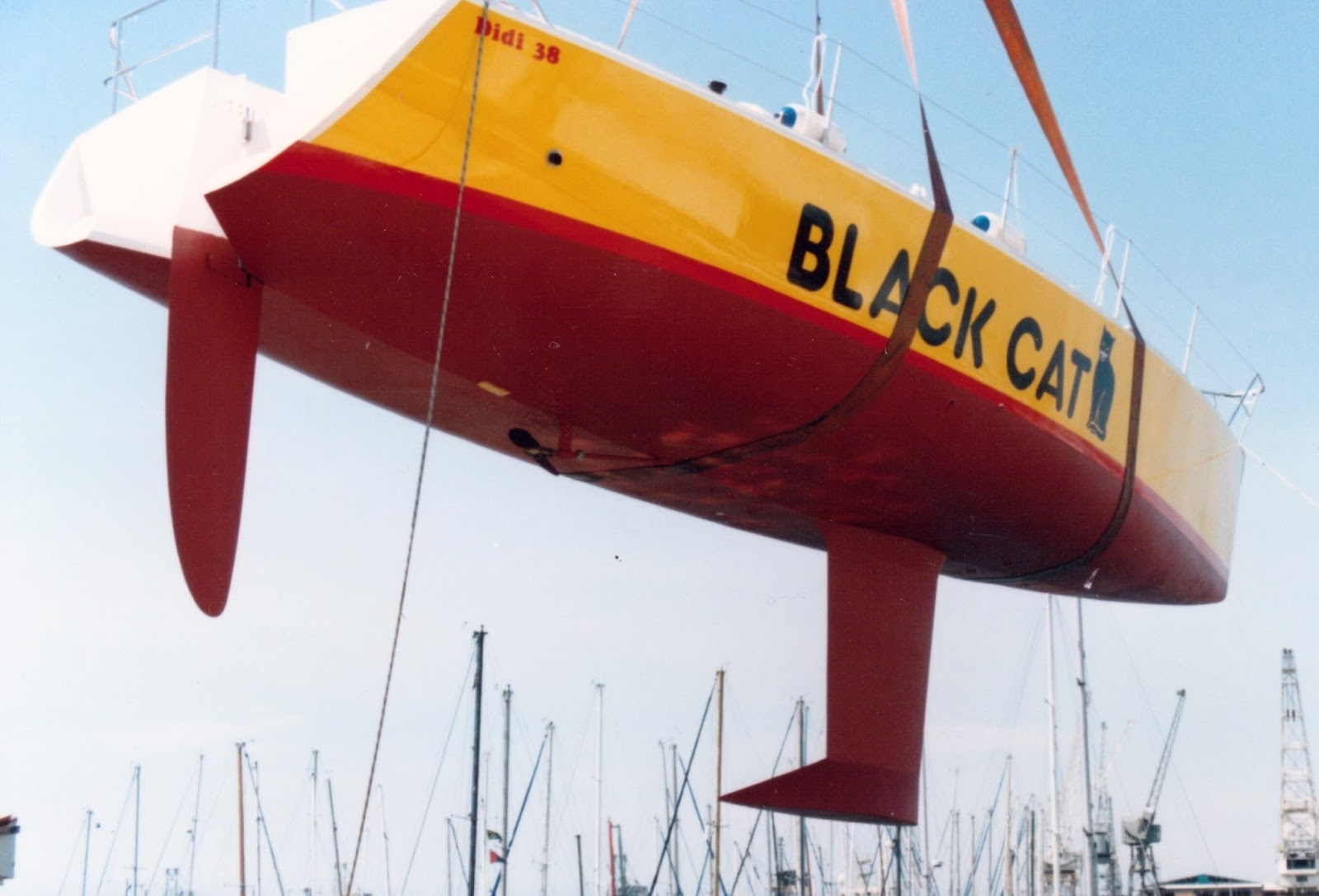
The launch of "Black Cat" 20 years ago.
I wish skipper Dave Immelman and his crew all the best for the race. I wish them great sailing, great results and, most of all, great friendships.

Friday, November 4, 2016

Cape to Rio Race 2017

"Black Cat", the Didi 38 that I built in 1994/5 for the 1996 Cape to Rio Race, is entered for the 2017 race, starting from Cape Town on 1st January. I was to be co-skipper for this voyage, along with Dave Immelman (Wavy), her resident skipper. Unfortunately, that plan has had to fall by the wayside. I damaged a knee during the 2014 Great Chesapeake Bay Schooner Race. That injury has somewhat limited my sailing on my Paper Jet skiff but not really affected anything else.
"Black Cat" soon after start of the 2014 Cape to Rio Race. Dave Mabin photo.
My knee suddenly worsened while sailing last month and can now immobilise me very suddenly. On a boat sailing trans-Atlantic is not the place to be with this injury, possibly endangering boat and crew in an emergency situation. Sadly, I have had to withdraw from the crew and "Black Cat" will now be skippered only by Dave Immelman. He is a very capable sailor, having skippered her to her win in the 2014 St Helena Race. Dave makes his living as an RYA sailing instructor with a sailing school in Cape Town.
This is me doing a repair on the headstay foil of
"Black Cat" during the 1996 Cape to Rio Race.
Gavin Muller photo.
I will have surgery on my knee next week, which will hopefully get me fully mobile again. I wish good sailing to Wavy and his crew, just sorry that I can't be there to share the voyage.