Showing posts with label Didi 38. Show all posts

Friday, March 30, 2018

Launching Didi 40cr2 Stargazer

I wrote last year about the Didi 38/40 projects being built by XS Marines in India. The posts are at Didi 26 and 40 Projects in India and Update on Wide Stern Versions of Didi 40 and Didi 40cr .

They built the new wide-stern version of the Didi 40cr, now named the Didi 40cr2, from plywood for a customer. (Sorry, we don't yet have a web page for the new version, that will come soon.) During the build, they took moulds off the hull so that they can build this series of designs in sandwich GRP. They will be able to build the Didi 38, Didi 40 and Didi 40cr from those moulds.

Last week they launched the first boat, named "Stargazer". She is the second Didi 40cr2 to be launched, after "Passion X" in Sydney, Australia.
"Stargazer" being built from wood and plywood.

"Stargazer" covered with the GRP mould.
Didi 40cr2 "Stargazer" about to get wet.
She was launched on Friday, sailed on Saturday and raced (not seriously though) on Sunday. She had no spinnaker, which was to be added to her wardrobe this week.

"Stargazer" under sail.
After their first sail, builder Sheri Bamboat reported on her sailing qualities. "We sailed Stargazer from the Moorings near my yard to Mumbai on 23 March .  It really was a great moment. I need to thank and congratulate you on one of the most well balanced boats that I have sailed."

We wish Sheri Bamboat and XS Marines every success with building these boats for the Asian market. We also wish the owner of "Stargazer" happy sailing and successful cruising and racing on her.

To see our full range of designs, go to our main website or our mobile website.

Tuesday, February 14, 2017

Up and Over with a Didi 40cr

David Edmiston in New South Wales, Australia, is building a Didi 40cr, in its newest form. This is with the hull flare increased aft to give more deck area and space for a T-shape cockpit. I haven't yet figured a decent name for this version, so for the moment it is the "Wide Stern Version of the Didi 40cr". David has made pretty good time building her, he is an amateur builder having bought his plans in May 2014.

Yesterday his boat made a major move, from his garden to a spot near to the water in Sydney Harbour. The start of that journey was unusual, in how the boat was removed from the building site. I will let the photos speak for themselves.
Lifted off her building cradle, this view shows the beautiful finish that David has achieved on his hull.
Up she goes.
And up some more. Note the spreader bars on the slings to relieve the squeezing loads that would be applied to the hull if they weren't there.
And over the roof. Few boats get to have such a good view of their building site. Her building cradle is at extreme right.
And onto a transporter for a quick ride to the harbour.
And away she goes, out of the neighbourhood. Being a wooden boat, her build will not have disturbed the neighbours much. Some of them may even miss watching a big project like this, which often becomes a focal point for gatherings and building neighbourhood spirit.
Her keel is delivered to the harbour. This is a steel casing with lead ballast poured in.
Then her hull is lowered over the bolts for initial dry-fit, followed by permanent bonding.
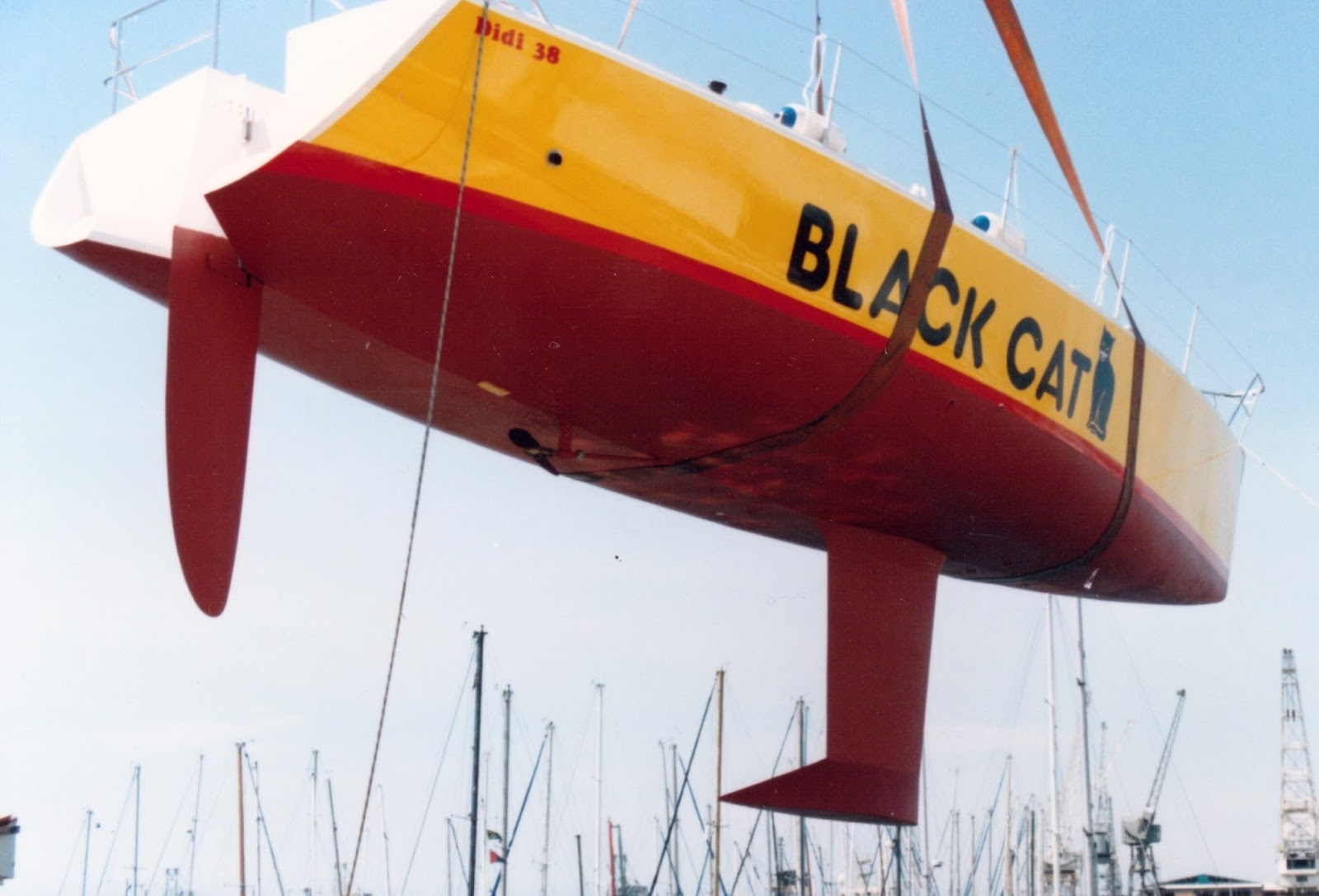
This is a slightly bigger sister to "Black Cat", the Didi 38 prototype that I built in Cape Town 20 years ago. It has the same hull but extended with a 2ft longer stern overhang. It also has a longer cabin with a bit more accommodation length.

It won't be long before David's new boat is in the water and sailing. I will post new photos when I have.

To see more of this and our other designs, go to our main website or our mobile website.

Wednesday, February 1, 2017

Black Cat Report from Rio

Didi 38 "Black Cat" arrived in Rio de Janeiro on 21st January in great style but with a very dead motor. One of the two cylinders had blown its head gasket a few days earlier. The motor was needed to charge batteries for the electrical needs of lighting, communication, instrumentation, navigation, watermaker etc., so they made some modifications to allow it to run on the remaining good cylinder. That eventually also gave in, so they received a tow from the finish line to the yacht club. A local mechanic has been assisting them to repair the motor.

Dave has given really good reports about their treatment at Iate Clube do Rio de Janeiro this year. That is good news for us yotties because the club members have been somewhat less than welcoming at the end of past races. This time crews have had full access to all parts of the club, whereas we were not permitted inside the clubhouse before. I had been lucky enough to have had meals in the excellent club restaurant in previous years because I was on the race committee, so had better than average privileges. Dave says that they have been very helpful with sorting out the engine problems as well.
Iate Clube do Rio de Janeiro
Most of the above came from Dave in a phone call. Here is his report received by email yesterday.
 
"Hi All

Just a quick update to let you all know what is happening here in Rio. We are still waiting on the mechanic, who yesterday, put the whole motor back together with newly done valves to gasket etc. We attempted to start and still no compression in cylinder no 2... After much discussion we stripped the whole motor out and are now looking at rings and pistons. Basically a major rebuild. So we wait again until Friday or Saturday. Not a problem just a bit frustrating. We did want to go to the Islands south of Rio, however that is now out of the plans. So we, with any luck, will be heading home on Saturday morning.

Rio and the yacht club here has been more than welcoming and a good time is being had by all.

Will send another update when things develop.

Cheers
Wavy"

Plans have changed since Dave wrote that report. With the motor out of the boat and being rebuilt in the mechanic's workshop, they decided to sail to the Bay of Islands for a few days of relaxed cruising before returning to Rio for the motor to go in again ahead of the voyage back home. They should be anchored somewhere around the idyllic Isla Grande right now.
I took this photo at my favourite spot in the Bay of Islands, Saco do Cue, in 1996. The little girl in the rubber duckie is my daughter, 8 years old at the time.
I will update when I have more info about their plans to depart Rio for Cape Town.

Tuesday, January 10, 2017

"Black Cat" Rio Race Report #3

Report # 3 from Dave "Wavy" Immelman, skipper of the Didi 38 "Black Cat", racing across the South Atlantic from Cape Town to Rio de Janeiro.

"We are fast approaching the half way. It has been a very eventful first half, so with any luck we have been through the hard times and are now heading for some lovely plain sailing. Ha ha fat chance this is the Atlantic Ocean. So we deal with what will come.

We are currently sitting on starboard gybe doing about 8 knots in 13 knots of wind with a small following sea under the light of a full moon. Sitting in shorts and PFD's. Does not get better than this!

The Black Cat sail repair team has been hard at work and the A0 is back in the sail locker and working. The S2 is also almost done. Eat your heart out North Sails.....Sorry Joe but there is plenty of work for you when we get back.

The guys and girl have all settled into the normal rigors of sea life. Broken sleep patterns, odd work hours.... The wind never seems to shift when everyone is on deck and ready but instead just as the off watch have just gone to sleep. How inconsiderate. But to a man they still get up and do their jobs.

It is very hot out here, in fact it seems hotter than normal but that might be me just getting older. It has however not stopped Josh and Shane doing their daily exercises. The joy of being young and full of energy.

The bath on the sugar scoop is a daily favourite. And it is a chance to cool off. For those who don't know, we put a harness on and step over the back onto the aft platform. There the water rushes in and out so one can bath and rinse in the Atlantic without having to stop and swim. We also have a frying pan tied to a lanyard for the odd shampoo.

Otherwise the crew are all well, if not well rested. The laughter is still thick and fast. The food is good, and the general mood is upbeat.

Cheers to all at home and keep in touch.


Black Cat crew."

Seems that they are enjoying themselves. We at Dudley Dix Yacht Design wish them happy sailing.

Friday, January 6, 2017

"Black Cat" Rio Race Report #2

Here in Virginia Beach we are under a blizzard watch for the next 24 hours, with possibly a foot of snow expected. Meanwhile, in the middle of the South Atlantic they are in mid-summer and hot. I was supposed to be there, not freezing my butt off in these temperatures and fixing my generator in preparation for potential power outages in the snow, ice and gales. Well, that is the way that it is and it does give me another 2 months to catch up on my work backlog.

Here is the second report from skipper Dave Immelman on the Didi 38 "Black Cat".

"Hi Everyone,

News from Black Cat.

Well, our first update from our trans-Atlantic Race is both good and bad. The great is that all on board are  well and in high spirits. We have all settled in to little sleep, sore fingers and squinting eyes, eating on the go and grabbing a quick 40 winks when we get the chance.

The weather has been a little trying and the sea state has been more than trying. SE, SW and S winds, with the sea coming in from all these directions. Cath described helming like being in a washing machine. Just as you get her on the surf, you suddenly get hit side on dunking the whole crew, throwing the boat into what can be only called a tail spin.

Due to this I made the call to head north as quickly as possible, also there was a strange looking system that was appearing on and off for the Thursday, so all things considered, flat following seas and trade winds seemed to be the answer.

We have, however, had a few setbacks. We managed to rip two of our kites, unfortunately this included our S2 (Our Biggest) and the A0. During the dropping of the A0 the head managed to get into the water (almost with the foredeck crew) and dragged under the boat. once we got it back on board it had a long tear along the foot. Then, while on a brilliant broad reach doing about 12 knots, the pole mutinied and dropped the guy! How I have no idea, but the end result was that the pole did a great javelin job right through the starboard clew.  This has slowed our daily progress. Then yesterday we managed to hook up some kind of flotsam which made the boat very slow indeed, as well as very hard to sail. After trying every manoeuvre I could to shake it, we eventually had to await first light, then I went into the water to free us from what looked like an old fishing net!
Free we jumped into high gear with the A3 and have had the most marvellous day surfing toward Rio. Music blareing, boys sewing, and jokes a plenty."

Good to hear that all is going well on "Black Cat". With reference to my analysis on race tactics in my previous blog post, the move to the north has continued and now includes almost the whole fleet, even those from the first start who are further along the course. As I said in an earlier post, I am not going to second guess Dave's decisions, he is there on the water, experiencing the conditions and also researching expected weather patterns. Now the fleet is moving up toward his chosen course.

Thursday, December 29, 2016

"Black Cat" in Cape to Rio 2017

I was to be co-skipper of "Black Cat" for this race, the 2017 iteration of the wonderful Cape to Rio Race, linking two beautiful cities that are separated by the South Atlantic Ocean. "Black Cat" is the Didi 38 that I built in my garden for the 1996 race. That plan to co-skipper her, partnered by Dave "Wavy" Immelman, came off track when I wrenched my already-damaged left knee while racing my Paper Jet skiff in Maryland a couple of months ago. When I got off my boat I could hardly stand and subsequent visits to doctors, followed by X-Rays, MRI etc. came up with sheer tears in both menisci of the knee. Able to only hobble around, surgery was scheduled and I felt that I would be a liability and danger to boat, crew and myself for the race. Sadly, I had to withdraw from the crew and will miss this race that I so enjoy.

I will still be involved though. "Black Cat" has satellite telephones aboard and they will be used to send me daily reports from the boat, with news about life aboard, how the race is going and anything else that is happening. They will also send me photos and possibly video footage as well. I will use that as material for posts on this blog.
"Black Cat" crossing the finish line of the 2014 Governor's Cup ocean race from South Africa to St Helena Island. Skipper Dave "Wavy" Immelman standing at the helm.
The race starts on Sunday 1st January at 14h00 local time, 12h00 GMT. The slower boats have already started their race, on Boxing Day (26th December). These are IRC Division 3 monohulls and Division 2 multihulls. Progress of the race can be followed via live tracking on XTra-Trak. This link works in Internet Explorer but doesn't seem to work properly in Google Chrome.

This is supposed to be a downwind race, with spinnakers hoisted in Table Bay and dropped off Guanabara Bay a few weeks later. I have raced in it four times and each time was very different from the others. Downwind conditions are not guaranteed. Storms along the way are almost a certainty, as evidenced by our capsize in the 2014 event. Hard racing, lots of fun and wonderful experiences that stay for a lifetime are a feature of this race, making close friendships that last for a lifetime. Close quarter living in such a small space brings out the best in people but it can also bring out the worst, so at the finish there will be a few people who will step off their boats and never want to see others in that crew again.
The launch of "Black Cat" 20 years ago.
I wish skipper Dave Immelman and his crew all the best for the race. I wish them great sailing, great results and, most of all, great friendships.

Friday, November 4, 2016

Cape to Rio Race 2017

"Black Cat", the Didi 38 that I built in 1994/5 for the 1996 Cape to Rio Race, is entered for the 2017 race, starting from Cape Town on 1st January. I was to be co-skipper for this voyage, along with Dave Immelman (Wavy), her resident skipper. Unfortunately, that plan has had to fall by the wayside. I damaged a knee during the 2014 Great Chesapeake Bay Schooner Race. That injury has somewhat limited my sailing on my Paper Jet skiff but not really affected anything else.
"Black Cat" soon after start of the 2014 Cape to Rio Race. Dave Mabin photo.
My knee suddenly worsened while sailing last month and can now immobilise me very suddenly. On a boat sailing trans-Atlantic is not the place to be with this injury, possibly endangering boat and crew in an emergency situation. Sadly, I have had to withdraw from the crew and "Black Cat" will now be skippered only by Dave Immelman. He is a very capable sailor, having skippered her to her win in the 2014 St Helena Race. Dave makes his living as an RYA sailing instructor with a sailing school in Cape Town.
This is me doing a repair on the headstay foil of
"Black Cat" during the 1996 Cape to Rio Race.
Gavin Muller photo.
I will have surgery on my knee next week, which will hopefully get me fully mobile again. I wish good sailing to Wavy and his crew, just sorry that I can't be there to share the voyage.

Wednesday, April 13, 2016

Didi 26 & 40 Projects in India

I wrote in February about the wide-stern version of the Didi 40cr that is being built in Australia. That post drew good interest and has resulted in various enquiries.

In a parallel development, we have been working with XS Marines in Mumbai, India on introducing new boats to their range of sailboats. This started with the owner of XS Marines, Sheri Bamboat, buying plans for the plywood Didi 26, as well as rights to build that design in fibreglass. Construction is now starting on that plywood boat, from which the moulds for GRP production will be made.
Bill Richards' plywood Didi 26  racing in New Zealand.
XS Marines will now take a similar route with the Didi 38/40, after having signed a buyer for the first boat that they will build to that design. They have requested to be able to build their boats with the newer wide stern, instead of the original stern that I built as "Black Cat". They also wanted to build the first plywood boat as a CNC kit. That required me to develop a revised 3D model and extract the modified hull and deck panels so that their kit could be cut. Under tight time pressure, it required some compromise from both sides but the job was done and the boat is now being built.
Didi 40 plywood hull being built at XS Marine in Mumbai.
This one is being built as a Didi 40, ie with the extended stern that increases sailing length and smooths the wake a bit. These differences translate into increased performance. The hull is the same as the Didi 40cr being built in Australia but with a shorter cabin and longer cockpit.
Pat Boase's Didi 40cr "Nimrod" racing off Durban, South Africa
Out of those moulds XS Marines will offer boats to both the Didi 38 and Didi 40 designs. We wish XS Marines the best of success with their new venture.

To see more of these designs and our full range, go to our full website or our mobile website.

Monday, July 13, 2015

"Black Cat" Launch Video

In November 1997 we launched our Didi 38 "Black Cat" after 2 years of building, only 2000 hours for an amateur-built ocean-crossing sailboat. That boat launched a whole series of designs and new developments in plywood boat construction.

That was 20 years ago. I had video of the occasion that was recorded off the TV with a VCR. It was bad quality and it was recorded on the PAL system used in South Africa. Attempts to convert to the NTSC format used in USA were pretty disastrous, resulting in unusable files.

Today I have received a good copy of the video, in a usable format. Watching the video now reminds me just how long ago this all happened. I didn't even have much grey hair then, now it is totally silver.
This video shows the shape of "Black Cat" very clearly. So many people came to me at that time and would not believe that this beautifully rounded shape was a plywood boat. Nobody had seen a rounded plywood hull before and they would only believe that it was not fibreglass after going inside to look at the structure.

Now my radius chine plywood designs are well-known and have been built in many countries. "Black Cat" is no longer unique but she remains the leader of an exciting time for plywood boatbuilding.

To see more of our boat designs, visit http://dixdesign.com/ or http://dixdesign.com/mobile

Tuesday, May 19, 2015

South Atlantic Capsize

Most of you will have read here or elsewhere about our adventure in the 2014 Cape to Rio Race on the Didi 38 "Black Cat". I have published a book about it, which can now be ordered from our website. For those who don't know what happened, here is a synopsis of the book, which is titled "South Atlantic Capsize - Lessons Taught by a Big Ocean Wave".

At dusk on 5th January 2014, the Didi 38 "Black Cat" was struck by a massive wave on the second day of the 2014 Cape to Rio Race across the South Atlantic Ocean. The wave capsized her in an instant, flinging crew, equipment and food around the interior and destroying most of the electronics with water that entered through the companion hatch. "Black Cat" recovered very quickly but the electrical damage was done. This is the story about the race, the boat, the crew and what happened on that day.
Front cover of the new book
It also explains the principles of stability that control the safety of monohull sailboats, mostly those characteristics that affect the behaviour of boats in large beam seas that might capsize them and the features needed to quickly return them to upright. It does this in words and terms that can be easily understood by non-technical people.
Back cover.
You will also read the story of the capsize of the 64ft "Sayula II" in the Southern Ocean when sailing between Cape Town and Sydney in the 1973 Whitbread Round the World Race, written by yacht designer Butch Dalrymple-Smith, who was one of the crew. Also what one boat owner has added to his own boat to prepare it and himself in case they are caught by conditions that place them at risk of capsize.

I managed to coerce two of the crew to also put pen to paper, to each write a short piece about his experience. I felt this to be important because we all observe events from our particular points of observation and positions in life. My view from the inverted cabin roof of Sean Collins hanging on for his life in the cockpit and of Adrian Pearson flying like a rag doll around the cabin is very different from that of Sean looking down the steep slope of a monster wave and seeing the masthead spearing into the ocean below, knowing that the boat will follow deck-first.  I would have liked to have had stories from the other two crew as well but they did not feel capable of effectively putting their stories into words.

You can buy the book at http://dixdesign.com/articles.htm. We can ship to you wherever you are, at our normal shipping rates.

To view our range of boat designs, please visit http://dixdesign.com/

Thursday, March 5, 2015

Yachting Monthly Capsize Video

Yachting Monthly have a very interesting  video of a capsize test on their YouTube Channel. I only became aware of it yesterday when it was highlighted by Scuttlebutt Sailing News.

Many have read the accounts that I have written about our capsize experience on the Didi 38 "Black Cat" in the Cape To Rio Race 2014. It is not possible to visualise what it is like to be there in that situation, even if you sit inside your boat and try to imagine it turning around you but this video goes a long way to help visualise it. It is not fully realistic because the roof stays at the top as the boat rotates, so the world is rotating around the boat rather than the boat rotating within the world around it. To provide better visualisation the camera needs to stay upright while the boat goes upside-down.

Bear in mind that this test is in flat water and the boat is rotated quite slowly from upright to upside-down, then rights itself quickly. Normally a capsize will happen in seas that are large and confused, so it is a much more violent process than seen in the video, with the boat being thrown in confused directions while it capsizes. Despite that, it is worth watching, to see the way that crew, equipment, etc was moved around the cabin and to see just how much water came in even in that still water.

It is not an experience that I would recommend to anyone, yet it is an experience that I am glad to have had and to have survived.

It also validates the toughness of the methods of construction that I have used for these plywood designs, that "Black Cat" came through with minimal damage.

To see our range of designs to carry you across the dam or around the world, please visit http://dixdesign.com/

Wednesday, February 4, 2015

What the Saints did Next

The Saints are the people who live on St Helena Island, a remote island in the middle of the South Atlantic Ocean. They live on a mountain of rock that comes straight up out of the ocean, with steep cliffs all round and nary a beach to be seen. The terrain is very convoluted, with deep valleys and mountain passes. Until now, the only way to reach St Helena has been by boat or ship but soon an airport will be completed, making the island more accessible to others and opening up the world to the islanders. This is an interesting place to visit on Google Earth, to see how remote and inhospitable it is. The new airport can also be seen; consider the mammoth task that it must be taking to create it with the minimal resources available on the island. I imagine that much equipment and material has been shipped in over the past few years to accomplish this.
Saloon view of "Black Cat". Photo courtesy of What The Saints Did Next.
St Helena is the finishing point for the Governors Cup Yacht Race, sailed from False Bay Yacht Club in Simonstown on the western side of False Bay, South Africa, every two years. It was also the place to which Napoleon Bonaparte was banished for his second imprisonment. It was far enough away from anywhere else that he was not able to get up to any more mischief.

What The Saints Did Next is the blog for the island, which helps to keep the world up to date with whatever is happening on the island. The blog has a great post about "Black Cat" and her win in the most recent edition of the race. It includes an interview with the crew about the race and life aboard, as well as a bunch of really nice photos of "Black Cat" and crew.

I hope that I can be on "Black Cat" for her next voyage in this race. Visiting St Helena is on my bucket list as a place to visit. An ancestor of mine and the first Dix to settle in Cape Town arrived from St Helena. What he was doing there I don't know, possibly a soldier guarding Napoleon.

"Black Cat" is the prototype of my Didi 38 design and forerunner of all of my radius chine plywood designs. Visit our website at http://dixdesign.com for more info on my designs.

Friday, January 16, 2015

The Governor, the Saint, the Cat & the Cup

The 2014 Governor's Cup Race from Simonstown, South Africa, to the South Atlantic island of St Helena, is all done and wrapped up. The results have all been sorted and the crew of the Didi 38 "Black Cat" have been presented with the magnificent glass floating trophy.
Sophie Pages, owner Adrian Pearson, Cathleen Hughes, skipper David Immelman & Shaun Cooper
The race started out in strong conditions that stayed with the fleet for much of the race, then disappeared. In battling through the extensive calms, most of the racing division boats chose to use their motors and defaulted into the cruising division, inflating the cruising fleet and decimating the racing fleet. Those who stuck to the ideals of yacht racing under wind power alone are to be congratulated for staying there to the end. In doing this, "Black Cat" and her crew won both line honours and on handicap.

For those who wonder where this place is, St Helena is the island to which Napoleon Bonaparte was exiled in 1815 after being defeated at the Battle of Waterloo. He was interred there in a tiny home until his death in 1821. The island is home to a small population of "Saints" under a governor who answers to the government in Great Britain.

The Governor's Cup Race occurs each year in the Southern summer, except for years when there is a Cape to Rio Race. It starts in late December and finishes early January, after crossing 1720 miles of open ocean. In past years boats have been able to ship back to South Africa on the RMS St Helena, a combined cargo and passenger vessel that has been the major physical connection between the island and the outside world in the past. Now the island has an airport that is nearing completion and which will soon be operational.
RMS St Helena offloading cargo.
The RMS St Helena service will be cut back considerably now and shipping of boats back to Cape Town may not be possible. It will be interesting to see what effect this has on entries for the Governor's Cup Race in the future.

This is a worthy race to enter if cruising around the world and passing through Cape Town. Also for kicking off a long distance or world cruise with South Africa as departure. From St Helena, the next stop of the trans-Atlantic leg would likely be the island of Ascension, another weeks sailing NW of St Helena, then on to Fernando de Noronha and mainland Brazil.

I have not yet visited St Helena but it is high on my bucket list.

Thursday, January 8, 2015

"Black Cat" in the Governor's Cup Race

In my last post I wrote about how well the Didi 38 "Black Cat" was faring in the Governor's Cup Race to the South Atlantic island of St Helena. I am writing this post based on information that I have read on the official web sites of the race and False Bay Yacht Club.

They were going like a train in showing the way to all of the monohulls. Then they sailed into a hole in the otherwise good tradewind sailing breezes. This was created by a rather odd shape to the South Atlantic high, as an elongated sausage running east/west and in two parallel bands of calm not far apart.

Skipper Dave (Wavy) Immelman was kicking himself for having missed a crucial weather download that may have helped him evade the holes. They sailed slowly through the first calm then the winds started to pick up and they thought they were through, only to be trapped by the second calm.
"Black Cat" rounding the Cape of Good Hope en-route to St Helena.

We watched in dismay as the Vickers 41 "Avanti" sailed a big arc that took her right around the hole in which "Black Cat" languished, at pretty much twice the speed. We despaired for the chances of "Black Cat" even catching "Avanti" before the finish line, let alone getting far enough ahead to beat her on handicap. In the end "Avanti" crossed the finish line about 7 hours 10 minutes ahead of "Black Cat".

I went to bed last night feeling sad that the hard sailing done by Wavy and his crew for so much of the race was thwarted by the fickle winds. I woke this morning to the news that the skipper of "Avanti" declared some time after finishing that they had motored and were dropping down to the cruising division. That leaves "Black Cat" as the likely winner of the racing division, with only "Iechyd Da" with a very distant chance of beating her on handicap.

Congratulations to Wavy and crew. You sailed an honest and honourable race. You didn't deserve the heartache that came from watching your opposition apparently sailing right around you when they had actually motored into a more favourable position.

This brings up two questions that need clarification.
  1. Why did "Avanti" wait until after the finish of the race to declare that they motored? They should have done so immediately that the motor was started. That action disqualified them from the racing division. They didn't declare at the time that they were dropping to the cruising division, so can they be considered to have been racing in that division? None of the other cruisers knew that they were racing against "Avanti" so they couldn't take her into consideration in their tactical decisions. The knowledge may not have had any effect but it should have been open knowledge throughout the fleet within hours of "Avanti" starting her motor.
  2. What is the sense of allowing boats to change their racing division on the water? It may have seemed a good idea at the time that the rules were written but has created a very unfair situation on the water, unfair to those boats that were in the cruising division at the start of the race. The entry list shows 9 boats in the racing division and 4 in cruising. As the race has progressed and the boats ran out of wind, racing boats have chosen to motor and change from racing to cruising division. The leading boat in cruising division changed class after finishing and the 2nd boat changed very late in the race. The whole balance of the event has changed, with the original 9 racers reduced to 3 and the original 4 cruisers swelled to 10 boats. Three of those 4 cruisers have retired and "Tallulah" should get the trophy. Instead she is lying 3rd, with "Avanti" and "Strumpet" having jumped in ahead of her. Maybe the rules of the race have not been broken but I don't agree that this is the right way to do it, in the interests of fairness to all on the water.
OK, I am getting off my soapbox now.Once again, congratulations to Wavy and crew on sticking it out in racing division when it looked like you had been beaten but could have had a clear win in the cruising division by simply starting your motor and changing classes.

See more about the Didi 38 and our other designs on our website at http://dixdesign.com/.


Friday, January 2, 2015

"Black Cat" on the Ocean Blue

I am sure that most of my readers are well aware of our adventures on the prototype Didi 38 "Black Cat" in the Cape to Rio Race in January 2014. This is the boat that I built in my back garden in Hout Bay, South Africa and launched nearly 20 years ago. She was the experiment in boat construction that is the basis for all of my radius chine plywood designs, with many hundreds now on the water or in build around the world.

"Black Cat" is once again out on the wide blue South Atlantic Ocean. She is participating in the 1700 mile Governor's Cup Race from Simonstown, South Africa, to St Helena, the remote island in the middle of the South Atlantic. Much as I would like to have been there, I was unable to join the crew for this race but they seem to be doing a pretty good job of it without my interference. They have led the monohull fleet both on handicap and on the water from the first position report and remain up there. Only the trimaran "Banjo" leads them.
"Black Cat" at start of Governor's Cup 2014. Dave Mabin photo
The crew, led by Dave Immelman, has been having great sailing, with three consecutive days of 200+ mile runs in strong downwind trade conditions. Now they are working their way through the light winds of a high pressure system at lower speed but maintaining their lead. Dave is the resident skipper on "Black Cat" and was my navigator for the Cape to Rio Race 2014.

We wish Dave and his crew continued good sailing and that they can find their way quickly through the high to more good breezes.