Showing posts with label plywood boat plans. Show all posts

Tuesday, September 22, 2020

Didi 40cr2 Kit at Exocetus Marine

 A few months ago I posted about the comprehensive kit being developed for the Didi 40cr2 by Exocetus Marine in UK. They are building a boat at the same time as developing the kit, to check everything for proper fit and assembly. Since my previous post the build has progressed to hull turn-over stage.

See captions under photos for explanations.

Side panel glued to hull framing.

First layer of pre-formed radius skin panels being installed.

This is how the radius skin panels are supplied in the kit, pre-formed in the Exocetus workshop.

Inside view of the radiused portion of the hull.

Second layer of radius fitted. A jigsaw joint on the side panel can also be seen.

Hardwood keel shoe, also cut by CNC. This forms a tough and flat surface onto which the keel root is bolted, removing compressive loads from the softer okoume plywood skin.

The gloss epoxy in this photo shows the fairness of the radius chine plywood hull. In the background is a Dix 470 catamaran that is also available as a kit, being built in the workshop.

High-build epoxy primer.

Outside, ready for hull-turning.

A novel way to turn a hull. I've not seen it done this way before.

The keel shoe is visible in this photo.

Steel frame on which the stern was supported during turn-over.

Turn-over completed.

The kit that Exocetus Marine is developing includes all plywood components plus all solid timber structure, pre-shaped and ready for installation. Their instruction manual is also very detailed, with interactive PDF 3D drawings that allow the builder to view in various formats and to zoom in to see finer detail.

To see our full design range, go to our main website or our mobile website.

Friday, June 19, 2020

Didi 40cr2 Kit from Exocetus Marine

Exocetus Marine in UK develops and supplies kits for our radius chine plywood catamarans, with kits produced for the Dix 470 and DH550 cats. A kit is currently in development for the new Dix 430 catamaran. The kits are very comprehensive and can be customized to each customer's needs, from basic bulkhead kits through to inclusion of whatever equipment and materials the particular builder would like to be delivered in the shipping container with the pre-cut plywood and other timber.

I have written about the Exocetus Marine kits in earlier posts on this blog, from when development first started in 2012. They have come a long way since then, under the expert hand of owner Kevin Bream.

CNC Kits for 47ft Plywood Catamaran
Dix 470 Catamaran Kit Build in UK
Kit-build Dix 470 Plywood Catamaran
Plywood Catamaran Kits
More About Plywood Catamaran Kits
DH550 Kit Shipped to Southern Africa
Dix 430 Catamaran

The DH550 catamaran "Valerie", built in Durban, South Africa, and in charter service in the Seychelles, was built from a very comprehensive kit supplied by Exocetus Marine, which included solid timbers, epoxies, engines, hardware, electronics, porthole frames etc.
DH550 charter catamaran "Valerie".
The Dix 470 catamaran "Marram", being built in Australia, is a big amateur project. The components have all been cut from CNC cutting files developed and supplied by Exocetus Marine.
Dix 470 "Marram", a husband and wife amateur project.
Exocetus Marine is now expanding their range in a new direction. This harkens back to my origins in radius chine plywood designs with my Didi 38 prototype "Black Cat", which has spawned a large and expanding range of designs from 15ft to 55ft, spanning both monohulls and multihulls. The Didi 38 design itself expanded to the Didi 40cr and, most recently, the Didi 40cr2. It is the Didi 40cr2 that is the newest project by Exocetus Marine.
"Passion X", prototype of the Didi 40cr2 design, built as an amateur project in Australia.
As with their catamaran kits, Exocetus is developing a very comprehensive kit for this first expedition into monohulls. In doing so they have transformed my CAD drawings into a complete 3D model before extracting the components for cutting by CNC then testing for accuracy of build. In doing this they are building the boat as well, enabling preparation of complete building instructions to guide those who will follow to build the Didi 40cr2 for themselves.

These photos are a few from the build record to date.
Bulkhead example, with jigsaw joints, doublers fitted around stringer slots.
All parts are referenced for identification and assembly instructions.
Bulkheads set up on the building stocks.
Cockpit structure installed, bracing the whole structure.
Backbone with bevels and scarphs pre-cut.
Pre-cut opening for propeller shaft log.
Laminated keel floors.
Keel floors installed through backbone structure.
Stringers being installed. This is a tangent stringer, with a doubler on the outer face for joining the radiused skin above the stringer to the flat skin below.
Hull side panels jigsaw-jointed at ends of sheets.
Example from the interactive building manual for the DH550 catamaran. A similar manual will be supplied with the Didi 40cr2 kit.
Check back to this blog occasionally. I will update here on progress of the kit development and the construction of their boat.

For more information on our designs go to our main website or our mobile website.

Monday, March 30, 2020

We Are Open For Business


I didn't realise that it is more than two months since my last post. Time flies when you are having fun, or busy. I am working on a 71ft aluminium cruiser, with the detailing taking a lot of time.

Our lives are being disrupted by the COVID-19 virus that is bringing the world to a standstill. Here in Virginia we are not yet in a lock-down situation but that is probably in our future before long. For now we are social distancing, chatting to neighbours at a distance and keeping contact with faraway family by Skype and WhatsApp.

I work from home, with my wife Dehlia as my only co-worker. We are able to work on as before despite the restrictions.

Many people are taking a break from their normal work, some enforced by authorities and others by choice, to ensure isolation from potential infection sources. We all hope that the situation will return to normal within a few weeks but that looks more and more unlikely.

When stuck at home, staying productive helps to fill the days and lift the spirits. A big enough project can involve most or all of the family, racking up quality time and keeping minds off wanting to be elsewhere. Making something worthwhile with our own hands is very satisfying and can provide the balance needed to keep us sane, reducing cabin fever.

If that something worthwhile that you build is a boat then you will have a new family toy when summer comes or when we can get to the water again. Some of my happiest times as a child were those spent sailing or fishing with my dad. As a teenager those prized memories were made on the water, rowing our family dinghies and, especially, sailing my own boat.

If you are already building one of our boats then nothing changes. Our personal backup, included in the price of our plans, continues as usual and we can advise when needed. If you are considering building, we will do all that we can to help you. We have offered study packs and dinghy plans for delivery as PDF files by email as an alternative to traditional paper prints. We will now expand this to include construction plans, under our normal terms of sale.

In the past most customers have been happy with paper plans sent by first class mail, transported by the airlines and delivered by the postal services in the destination country. There have been massive cutbacks in air travel, so most of the aircraft that would have carried the packages to faraway places are grounded. With so few planes, airmail services are under pressure and have slowed considerably, aggravated by slower delivery in the destination country due to restrictions in movement of people. The alternative of courier service speeds up delivery but is costly. Receiving the plans as PDF files may be a viable option for some builders.

PDF files do have drawbacks, related to the size of the drawings that you will be using. Most of them were drawn to A1 size of 491x841mm (23.4x33.1"). These are way too big to print on a standard A4 or letter size printer but you can view them on-screen and zoom in to see details. You may be able to print sections of a drawing or your printer may have a nesting feature to print in sections for taping together into a single sheet. The best option is to take the files to a print shop for printing on a large format inkjet printer.

Here are samples of drawings to show what you will receive for two different types of designs. Click on the links to see them online, which will have limited clarity. Download into your computer and view in a PDF Reader program. Zoom in to appreciate the greater clarity that is available.
Sample PDF file of a CAD drawing, applicable to most of our designs drawn since 1995.
Sample PDF file of a hand-drawn drawing, applicable to most of our designs before 1995.

Some of our designs include full-size patterns, which we normally print on 36" Mylar roll media. Some of them are as long as 16ft, totally impractical to print in small sections with an expectation of accuracy. These must be printed on a wide format printer. You can print on paper instead of Mylar if you store them in a sealed plastic sleeve and use them within a few weeks. Delaying their use risks dimensional change due to variations in humidity.

Whichever delivery method you choose, we can supply any design from our pricelist, except for the Trika 540. This was drawn by a colleague and is only supplied as paper prints, shipped from Germany.

We wish all of our supporters and families continued good health through this worldwide crisis.                                                                                                                  

Friday, January 24, 2020

Memories of a Trans-Atlantic Race

This week I was sent a photo that brought back good memories, 24-year old memories of our first Cape to Rio Race on "Black Cat", in 1996. It was sent to me by Gavin Muller, who was the youngest in our 5-man crew. He took it on the last night of our race, as we were sailing between our Brazilian landfall of Cabo Frio and the finish line off Copacabana Beach, Rio de Janeiro.
From left, Adrian Pearson, Brian Cole, Dudley Dix and Sean Collins. Sadly, two are no longer with us, the others are scattered around the world.
The Cape to Rio Race is 3500 miles of tradewind ocean racing, starting in Cape Town and finishing in Rio de Janeiro. A race like this breeds friendships that last a lifetime. Most of us were good friends before the race and the three weeks in close quarters in the middle of nowhere, in company of seabirds and the occasional fish or whale, cemented those friendships forever. Gavin was the odd-man-out at the start of the race, being much younger than the rest of us, but he too became a friend for life.
Gavin Muller repairing our light spinnaker.
Adrian Pearson (RIP) was my partner in "Black Cat". Brian Cole introduced us while I was building our boat for the race, bringing him in as crew. Later he joined me to co-finance the project.

Brian Cole (RIP) was the oldest in our crew, at 60. He was a director of North Sails Cape Town and a regular on the crew of my previous boat, "Concept Won". He joined us on this race as navigator for his first and only ocean-crossing voyage. His wife, Marion, was co-skipper with Judy Provoyeur of the all-lady crew of the Schumacher 41 "Kelly Girl", our closest handicap competition in the race. On handicap, they had to reach Rio more than 20 minutes ahead of "Black Cat" to beat us.

Sean Collins was a client many years ago for a rig redesign on his cruiser. He became a friend, sailing with me for many, many miles on "Concept Won". We raced together uncountable times in fully-crewed and double-handed races around the buoys and around the coasts of the Cape of Good Hope, quite justly also named "Cape of Storms". We had much experience sailing in mild weather and in those storms.

Gavin Muller, at 21, was not long out of college. His math teacher, an acquaintance and also a boat owner at Royal Cape Yacht Club, had asked me if I had a crew slot available for Gavin, who had previously sailed a Cape to Rio Race with him while still a school boy. Another friend of mine had to withdraw from the crew and Gavin slid into his spot.
Another of Gavin's photos. This one shows me in the bosun's chair working on the headstay foil, damaged by the spinnaker pole. The big cat watches over me.
"Black Cat" is the prototype of my Didi 38 radius chine plywood design. I designed her primarily for this race, starting to formulate the concept while racing to Rio in 1993 as navigator and sailing master on the Shearwater 39 "Ukelele Lady". I built her in my garden in Hout Bay, a suburb of Cape Town. The build took 2 years with help from my wife Dehlia, Sean Collins and another friend, Nigel Watkins, who didn't join us for the race.

Part-way through that race, with the nearest land (the Brazilian island of Trinidade) about 500 miles away, we had a close call with a boat of about 40ft that was sailing unlit on a moonless night. I was in my berth under the cockpit, dozing with my brain on alert as usual. Brian and Adrian were in the cockpit and I heard a discussion start, trying to identify something ahead of us in the dark. We were under spinnaker, averaging about 10 knots, so closing pretty fast. I joined them in the cockpit to see that we were on course to T-bone this wooden boat. Two wooden boats colliding in mid-ocean would not have been pretty. The skipper of the other boat suddenly appeared on deck, shining a flashlight on his mainsail. Within another 15 seconds we would have been past him and would have made much noise to advise him that he had missed out on the action of unidentified ships passing in the night. I suspect that he still holds those images in his head of our big cat spinnaker bearing down on him fast.

We figured from his course and position that he was possibly en-route from Cape Horn to Europe. Next morning on the daily fleet report I told of our near-miss. The story appeared in the Cape Town newspaper next day, although not entirely accurately reported. We were also the subject of the daily cartoon, the original of which now hangs proudly on my wall at home.
The cartoon drawn by Grogan for the Cape Argus newspaper.
We had not seen our competition "Kelly Girl" since the start but they were always close behind in the handicap race. We hadn't seen another boat for many days although the position reports showed that there were always others somewhere over the horizon. Trinidade was a mark of the course and, as we approached the island toward sunset one day, we saw "Kelly Girl" behind us on the horizon. After that we saw each other at least once a day.

A few days after rounding Trinidade we were sailing in 5000m of inky blue water that suddenly turned brown and murkey. We hadn't seen a seabird for a few days and had hooked nothing on our fishing lure, trailed for many days. At the same time the sky was full of birds and our lure hooked a long-fin tuna. Within 5 minutes we had three of them aboard before deciding to keep the lure aboard rather than have nature think us greedy. The truth is that, with one fish for dinner that night and the other two in the freezer, we could not cope with any more. Within an hour we were back into inky blue water and 5000m of water, having completed our crossing of the 60m depth of the Almirante Saldanha Sea Mount. In another million years or so maybe this will be another island in the Atlantic.

Meanwhile our race-within-a-race carried on with us sometimes ahead and other times "Kelly Girl" appearing out of a thunder storm ahead of us. Cabo Frio was our first landfall in mainland Brazil and we rounded that promontory abeam of each other and 100 yards apart. We finished about 3am that night, about an hour ahead of "Kelly Girl", with the 20 minute handicap advantage in hand as well. Another 4 years on, in the 2000 Cape to Rio Race that same boat was skippered by circumnavigator Anthony Steward, who finished about 20 minutes ahead of us. These two boats are very closely matched for ocean racing.
Relaxing in the Bay of Islands after the race.
Since that 2000 Rio Race "Black Cat" has crossed this ocean twice more, to total six Atlantic crossings. She has also raced the 1700 mile Governor's Cup Race from Cape Town to St Helena Island twice, including line- and handicap-honours in the 2014/15 race.

It is now 24 years that "Black Cat" has been sailing. She has nearly 100 sisters on the water or in build. She has also spawned another 16 performance designs in sizes from 15 to 55ft for a wide range of concepts. These range from monohull dinghies to trailer-sailers and large catamarans, even fast little gaffers. More than 500 boats are on the water or being built to this range of designs. Most are amateur projects, with builders producing impressive quality.
Didi 29 Retro, a gaffer with a great turn of speed.
DH550, a very comfortable and eye-catching cruising cat.
Both of the boats above, as different as they may appear, are derivatives of the Didi 38 design. To see our other plywood designs go to https://dixdesign.com/plywood.htm. Or to see our full range of designs of all types and materials, go to our main website or our mobile website.

Thursday, July 11, 2019

Sailing the Argie 15

I designed the Argie 15 in 1988 for the Argus Newspaper Group in South Africa. They named it after the street corner sellers of their newspapers, the Argie Boys, as a dedication to them. In the more than 30 years since many hundreds of these boats have been built and they are to be found in 60 countries.

I was the first person to sail an Argie 15, the prototype that was built by journalist David Biggs. He produced the weekly DIY supplement for the newspaper and commissioned the design as a DIY project for his readers.
That is a young me at the helm, journalist David Biggs as crew, on the maiden sail of the Argie 15 prototype.
We sailed among the moored boats of False Bay Yacht Club, in about 8-10 knots of breeze, with the boat behaving beautifully. Many boats were built from the articles in newspapers and magazines, as well as plans bought from us, generating a strong following.

I didn't get to sail an Argie 15 again for nearly 30 years, when we launched our own boat three years ago. In all that time I only heard good reports about the handling characteristics of boats to this design. Then, a few months ago, a new builder asked me about the comments that he had read of these boats having lee helm and how to remedy it. I had not seen these comments and told him that I would do some testing with my boat when on a planned sailing trip to North Carolina in June.

That sailing trip was a few weeks ago. I went out by myself in light and fluky conditions that gradually built to about 15 knots and gusty afternoon sea-breeze. This gave me opportunity to test in a range of conditions.

I like to sail from well forward in my boats in light conditions, so I fitted my long tiller extension, a 6ft length of bamboo connected to the tiller by a short length of flexible hose on a pivot bolt. This would enable me to sail from anywhere in the cockpit, from far aft through to sitting on the centre thwart. I had seen in photos that some owners helm from aft, alongside the tiller, so I needed to test this position although I knew it would create problems.

This proved to be the case, with fore/aft trim having a big effect on helm balance. With weight aft, she trims bow-up and the bow gets blown downwind because the centre of lateral area moves aft. The hull should float close to the attitude shown on the sail plan to get the balance between sails and underbody correct.  If sailing alone, sit well forward, alongside the daggerboard. With other people aboard and sitting toward the front of the cockpit the helmsman can move aft, as seen in the photo of the prototype, keeping the boat fairly level. Just because you can sit next to the tiller is not a good reason to do so, trimming the boat level is what is needed.

Trimming the boat so that it heeled to leeward or windward also had a large effect on the helm balance. Sailing in steady light breeze while sitting on the windward side gave me lee helm but sitting on the leeward side gave me weather helm. In light but gusty conditions, sitting on the windward side, I had lee helm in the lulls and weather helm in the gusts. I then sailed downwind, standing in the middle of the cockpit, with one foot on each side of the cockpit. This allowed me to push down on either foot to change the heel angle. With the rudder on centreline I was able to steer the boat to either side as much as I wanted, with my feet. Pushing down on the windward side heeled it to windward and gave lee helm, pushing the bow toward the leeward side. Pushing down on the leeward side did the opposite.

This results from changes in the shape of the immersed portion of the hull with changes of heel angle. When heeled over to leeward, which is the correct attitude when sailing, the leeward side of the hull becomes more curved and the windward side becomes less curved. The neat symmetrical hull shape when upright changes to somewhat of a banana shape when heeled and that banana shape turns the boat toward the high side.

At the same time the centre of the sail area, through which the wind drives the boat forward, moves off to leeward of the hull. The drag from the water, holding the boat back, stays at the hull. This results in a lever with the sails pushing forward at the one end and the hull holding back at the other end. This causes the boat turn to windward, i.e.to have weather helm.

Those two effects from heel that create the desired weather helm will also work in reverse. Heel your boat to windward instead of to leeward and those effects will move to the other side of the boat and give you lee helm.

The effect of fore/aft trim and heel on helm balance is common to most boats of all sizes that have a fin keel, centreboard or daggerboard. I used these affects on my Didi 38 "Black Cat" to maximize boat speed in light to moderate conditions. In light breeze I had most of my crew to leeward on the foredeck. As the wind increased I gradually moved crew aft and to windward, one person at a time, thereby adjusting the amount of weather helm by changing the fore/aft trim and heel angle. It works exactly the same in a dinghy like the Argie 15.

The take-away lesson from this is that you can adjust the helm to suit yourself, between lee helm, neutral and weather helm, by moving weight around the boat. For the Argie 15 the main points are:-

1) It should not be sailed bow-up but it does not mind sailing bow-down. In light conditions I would sail it bow-down but would trim it level fore/aft for most other conditions. In strong conditions downwind I would get weight further aft, as is normal with most boats.

2) It should not be sailed heeled to windward. Crew don't have to sit on the windward side, they can sit wherever needed to get the nicest feel for the helm in light conditions. In stronger breeze the boat will naturally have weather helm and will need the crew to windward for stability. Again, this is the same for most other boats.

There are also sail adjustments that can affect the helm. More power from the sails increases weather helm. Sails that are full (lots of camber) generate a lot more power than sails that are flat, so they create weather helm. Increase power in the mainsail for light breeze by slacking the foot to increase camber. With a jib that has the forestay inside a sleeve at the luff there should be a line at the bottom of the luff, tying it to the eye of the stay. This line is used to adjust the tension of the luff, which adjusts fullness of the sail. Tighten the line to flatten the sail and loosen it to make the sail more full for more power. If you have Cunningham lines rigged on your boat for jib and mainsail you will use them to adjust luff fullness.

Whether you have an Argie 15 or some other dinghy or small keelboat, you can test these principles on your own boat. When you know the characteristics of your boat you will improve its performance and your racing results.

To see our range of boat designs, go to our main website or our mobile website.

Thursday, February 28, 2019

Cape Henry 21 & Kits in Australia

The most recent Cape Henry 21 launch was in Adelaide, Australia. "Sealion" is beautiful, built by Ron Jesche, and painted a very pretty blue. Ron is a professional boatbuilder with other boatbuilding projects behind him but most boats to this design are built by amateurs. With more than 100 afloat or in build around the world, this is our most popular plywood traditional sailboat design.
Ron Jesche exhibiting "Sealion" at the Geelong Wooden Boat Festival.
 Ron made a lovely job of the build, both inside and out, with quality joinery. The bright-finished details against white surfaces are traditional finishes for classic boats and create a bright and airy interior.
Pretty detailing, nice finishes. The slatted liners are comfortable backrests for the settees.
The raised sheer and flush deck give a comfortable and spacious interior.
Afloat and waiting for her sails.
Ron made some custom changes to his boat. One of them was to add a small diesel motor under the front of the cockpit to replace the standard outboard motor in an outboard well. It fits in neatly, with access through hatches in the cockpit sole and bulkhead. Although the diesel motor is a bit heavier than the outboard that it replaces, it is closer to the centre of gravity of the boat, so has little effect on flotation.
Cockpit hatches to access engine and shaft seal.
Access openings in bulkheads around the engine.
Ron launched on Christmas eve and had the first sail as a Christmas present. Since then he has sailed her in a wide variety of conditions on all points of sail and tested her for heaving to. He had previously sailed the smaller sister, Cape Cutter 19, and declared them both to be fast, capable and without vices.
"Sealion" romping in a friendly summer breeze, sailing as a cutter with Yankee and staysail.
A few days ago he sent this photo, taken while sailing in light breeze. It was his first outing with Genoa and main, sailing as a sloop. He discovered just how fast these little boats are in light winds.
Reaching at 6.1 knots boat speed in 7.8 knots apparent breeze.
While building his Cape Henry 21, Ron Jesche agreed to work as our agent in Australia and since then we have expanded it to include CNC kits for our plywood designs. He is well placed to represent us at boat shows and in the plans and kit markets. To contact Ron Jesche, go to his Stainless Boatworks website at https://stainlessboatworks.com.au/.

To see more of this design or others in our wide range, go to our main website or our mobile website.

Friday, January 11, 2019

Didi 27 Retro

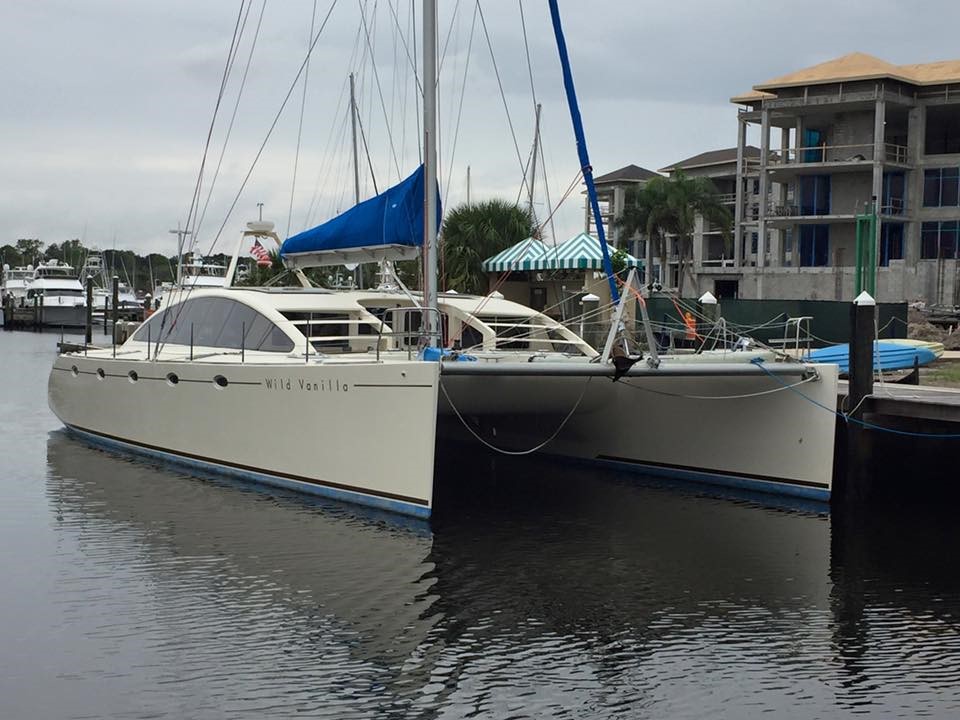
It has been a few years since we introduced the Didi 29 Retro, a gaff-rigged cruiser-racer based on our popular Didi 26 trailer-sailer sportboat. Bruce Mierke of North Carolina built his "Arabella" to this design with a modified (shorter) cabintop. Sisters are also being built in Africa, Europe, Asia and Australia.
Didi 29 Retro "Arabella", built by Bruce Mierke.
Inspired by "Arabella", another client commissioned a boat on the same basis but heading in a slightly different direction. The new boat is a classically-styled day-sailer with enough horsepower for exciting sailing.

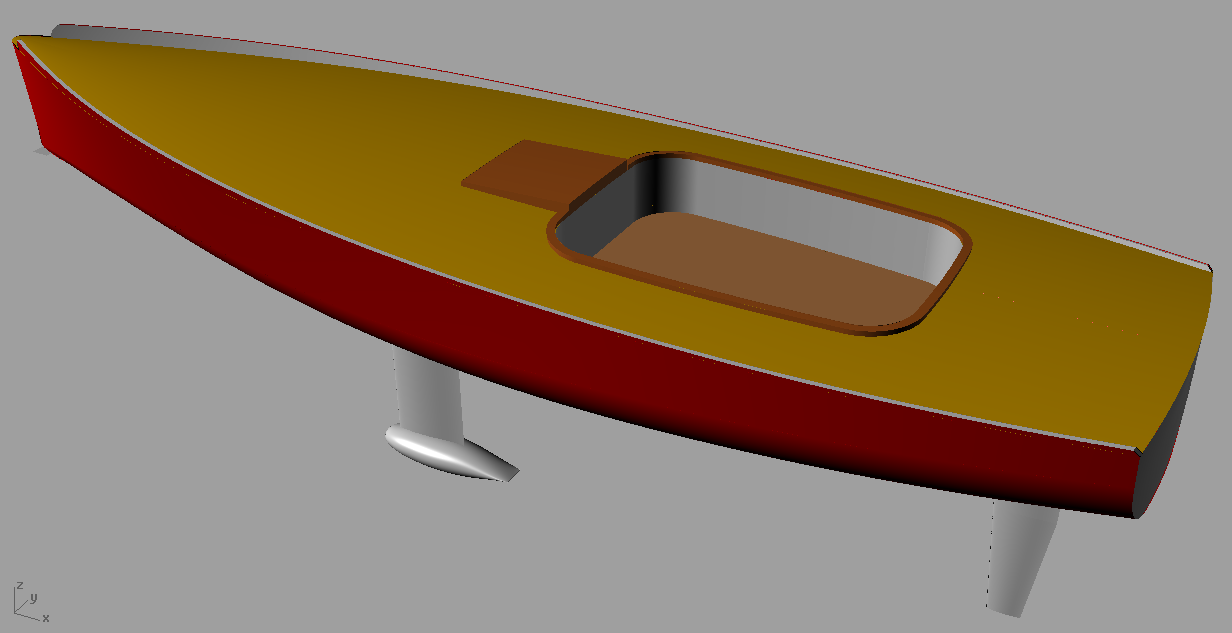
The hull is based on the Didi 26, with some modifications. It has a plumb bow and aft the lines have been extended for a clean and powerful stern, ending in a radiused vertical transom. Along with that it has bulwarks forward, which taper aft into a normal toerail. The result is a more springy sheer curve.
Clean flush deck and centre cockpit
Bulwarks, bulb fin keel and spade rudder.
Being a dayboat, it has a clean flush deck with centre cockpit and no cabin structure. My client wanted only two settees down below with sitting headroom but I included a double forward berth to add the option of camp-cruising. A Porta-Potti and camp stove can be stowed under the cockpit and a boom tent can extend sleeping space to include the cockpit.
Powerful Marconi rig.
The rig is a powerful fractional Marconi sloop configuration, with square-head mainsail. The asymmetric spinnaker is flown off the end of a retracting and pivoting bowsprit. The deck-stepped mast is supported by double swept spreaders and there are also runners to help with the loads from the asymetrical in strong winds.
Camp-cruiser accommodation
My client wanted a fixed keel and a lifting keel will also be available. The foils are wood, sheathed in uni-directional glass, with a cast lead ballast bulb. The rudder is in a cassette that allows it to be lifted for servicing and for the lifting keel boats to get into shallow water.

We will be offering CNC kits for this boat, including the interior components. Plans are available immediately and kits in the near future.

To see our other designs, go to our main website or our mobile website.