Showing posts with label radius chine plywood boat. Show all posts

Friday, January 24, 2020

Memories of a Trans-Atlantic Race

This week I was sent a photo that brought back good memories, 24-year old memories of our first Cape to Rio Race on "Black Cat", in 1996. It was sent to me by Gavin Muller, who was the youngest in our 5-man crew. He took it on the last night of our race, as we were sailing between our Brazilian landfall of Cabo Frio and the finish line off Copacabana Beach, Rio de Janeiro.
From left, Adrian Pearson, Brian Cole, Dudley Dix and Sean Collins. Sadly, two are no longer with us, the others are scattered around the world.
The Cape to Rio Race is 3500 miles of tradewind ocean racing, starting in Cape Town and finishing in Rio de Janeiro. A race like this breeds friendships that last a lifetime. Most of us were good friends before the race and the three weeks in close quarters in the middle of nowhere, in company of seabirds and the occasional fish or whale, cemented those friendships forever. Gavin was the odd-man-out at the start of the race, being much younger than the rest of us, but he too became a friend for life.
Gavin Muller repairing our light spinnaker.
Adrian Pearson (RIP) was my partner in "Black Cat". Brian Cole introduced us while I was building our boat for the race, bringing him in as crew. Later he joined me to co-finance the project.

Brian Cole (RIP) was the oldest in our crew, at 60. He was a director of North Sails Cape Town and a regular on the crew of my previous boat, "Concept Won". He joined us on this race as navigator for his first and only ocean-crossing voyage. His wife, Marion, was co-skipper with Judy Provoyeur of the all-lady crew of the Schumacher 41 "Kelly Girl", our closest handicap competition in the race. On handicap, they had to reach Rio more than 20 minutes ahead of "Black Cat" to beat us.

Sean Collins was a client many years ago for a rig redesign on his cruiser. He became a friend, sailing with me for many, many miles on "Concept Won". We raced together uncountable times in fully-crewed and double-handed races around the buoys and around the coasts of the Cape of Good Hope, quite justly also named "Cape of Storms". We had much experience sailing in mild weather and in those storms.

Gavin Muller, at 21, was not long out of college. His math teacher, an acquaintance and also a boat owner at Royal Cape Yacht Club, had asked me if I had a crew slot available for Gavin, who had previously sailed a Cape to Rio Race with him while still a school boy. Another friend of mine had to withdraw from the crew and Gavin slid into his spot.
Another of Gavin's photos. This one shows me in the bosun's chair working on the headstay foil, damaged by the spinnaker pole. The big cat watches over me.
"Black Cat" is the prototype of my Didi 38 radius chine plywood design. I designed her primarily for this race, starting to formulate the concept while racing to Rio in 1993 as navigator and sailing master on the Shearwater 39 "Ukelele Lady". I built her in my garden in Hout Bay, a suburb of Cape Town. The build took 2 years with help from my wife Dehlia, Sean Collins and another friend, Nigel Watkins, who didn't join us for the race.

Part-way through that race, with the nearest land (the Brazilian island of Trinidade) about 500 miles away, we had a close call with a boat of about 40ft that was sailing unlit on a moonless night. I was in my berth under the cockpit, dozing with my brain on alert as usual. Brian and Adrian were in the cockpit and I heard a discussion start, trying to identify something ahead of us in the dark. We were under spinnaker, averaging about 10 knots, so closing pretty fast. I joined them in the cockpit to see that we were on course to T-bone this wooden boat. Two wooden boats colliding in mid-ocean would not have been pretty. The skipper of the other boat suddenly appeared on deck, shining a flashlight on his mainsail. Within another 15 seconds we would have been past him and would have made much noise to advise him that he had missed out on the action of unidentified ships passing in the night. I suspect that he still holds those images in his head of our big cat spinnaker bearing down on him fast.

We figured from his course and position that he was possibly en-route from Cape Horn to Europe. Next morning on the daily fleet report I told of our near-miss. The story appeared in the Cape Town newspaper next day, although not entirely accurately reported. We were also the subject of the daily cartoon, the original of which now hangs proudly on my wall at home.
The cartoon drawn by Grogan for the Cape Argus newspaper.
We had not seen our competition "Kelly Girl" since the start but they were always close behind in the handicap race. We hadn't seen another boat for many days although the position reports showed that there were always others somewhere over the horizon. Trinidade was a mark of the course and, as we approached the island toward sunset one day, we saw "Kelly Girl" behind us on the horizon. After that we saw each other at least once a day.

A few days after rounding Trinidade we were sailing in 5000m of inky blue water that suddenly turned brown and murkey. We hadn't seen a seabird for a few days and had hooked nothing on our fishing lure, trailed for many days. At the same time the sky was full of birds and our lure hooked a long-fin tuna. Within 5 minutes we had three of them aboard before deciding to keep the lure aboard rather than have nature think us greedy. The truth is that, with one fish for dinner that night and the other two in the freezer, we could not cope with any more. Within an hour we were back into inky blue water and 5000m of water, having completed our crossing of the 60m depth of the Almirante Saldanha Sea Mount. In another million years or so maybe this will be another island in the Atlantic.

Meanwhile our race-within-a-race carried on with us sometimes ahead and other times "Kelly Girl" appearing out of a thunder storm ahead of us. Cabo Frio was our first landfall in mainland Brazil and we rounded that promontory abeam of each other and 100 yards apart. We finished about 3am that night, about an hour ahead of "Kelly Girl", with the 20 minute handicap advantage in hand as well. Another 4 years on, in the 2000 Cape to Rio Race that same boat was skippered by circumnavigator Anthony Steward, who finished about 20 minutes ahead of us. These two boats are very closely matched for ocean racing.
Relaxing in the Bay of Islands after the race.
Since that 2000 Rio Race "Black Cat" has crossed this ocean twice more, to total six Atlantic crossings. She has also raced the 1700 mile Governor's Cup Race from Cape Town to St Helena Island twice, including line- and handicap-honours in the 2014/15 race.

It is now 24 years that "Black Cat" has been sailing. She has nearly 100 sisters on the water or in build. She has also spawned another 16 performance designs in sizes from 15 to 55ft for a wide range of concepts. These range from monohull dinghies to trailer-sailers and large catamarans, even fast little gaffers. More than 500 boats are on the water or being built to this range of designs. Most are amateur projects, with builders producing impressive quality.
Didi 29 Retro, a gaffer with a great turn of speed.
DH550, a very comfortable and eye-catching cruising cat.
Both of the boats above, as different as they may appear, are derivatives of the Didi 38 design. To see our other plywood designs go to https://dixdesign.com/plywood.htm. Or to see our full range of designs of all types and materials, go to our main website or our mobile website.

Wednesday, November 7, 2018

Didi 40cr Opportunity in New Zealand

The Didi 40cr is a variation of our Didi 38 design, of which my "Black Cat" was the prototype. We launched "Black Cat" in November 1995; she will be 23 years old in a few days and has crossed the South Atlantic 6 times. There are more then 80 sisters sailing or in build around the world.

A builder in Whangarei, New Zealand, has built his Didi 40cr hull to a good standard but is not able to carry on with it. He is relocating to UK and cannot take the boat with him. His project is available at no cost to another builder who would like to own and sail a fast cruiser/racer like this.

The hull structure is mostly completed, so will give a builder a head-start of 1000 or more hours in saved building time.
Most of hull structure completed.
Neatly executed woodwork.
The hull is still upside-down on its building stocks, mounted on a road trailer and protected from the weather by a tarp. The trailer is available to move the hull but must be returned to its owner.
Hull on building stocks, mounted on road trailer.
For more information on this opportunity, go to the listing at
https://www.trademe.co.nz/Browse/Listing.aspx?id=1812843342, from where you can contact the owner directly.

Sunday, May 13, 2018

Didi 40cr2 Builder Sheri Bamboat

Sheri Bamboat is the owner of XS-Marines, boatbuilder in Mumbai, India. They built the plywood Didi 40cr2 "Stargazer" for a customer and took moulds off that boat for future production building of the Didi 38/40 design range in sandwich GRP. Today an article appeared in Indian newspapers about Sheri Bamboat, telling the story of his involvement in sailing and boatbuilding in India. Read Sheri's story in the Mumbai Mirror.

Didi 40cr2 |Stargazer".
To  see our range of designs, go to our main website or our mobile website.

Thursday, February 23, 2017

Didi 40cr Launch in Australia

David Edmiston launched his Didi 40cr "Passion X" at Woolwich Dock in Sydney yesterday. Today the Allyacht Spars Australia rig was set up by Joe Walsh Rigging. Halliards and other rig control lines have been run through the deck hardware to their stoppers and winches and the guardrails are being installed. Soon she will only need her sails before she can go out for her sea trials.
"Passion X" gets her first taste of salt water in the travel lift at Woolwich Dock.
"Passion X" afloat and awaiting her rig.
Deck-stepped fractional double-spreader rig.
David reports that she is floating nicely on her lines.
"Passion X" nearly ready to go.
"Passion X" could be sailing as soon as this weekend. I will post photos as soon as I have them.

To see more of this and our other designs, go to our main website or our mobile website.

Thursday, March 10, 2016

More about Plywood Catamaran Kits

Yesterday I posted about the kits for our big catamarans developed by Exocetus Yachts in UK. There has been a lot of interest in these kits, so today I am showing more detail about what is supplied to assist the builder.

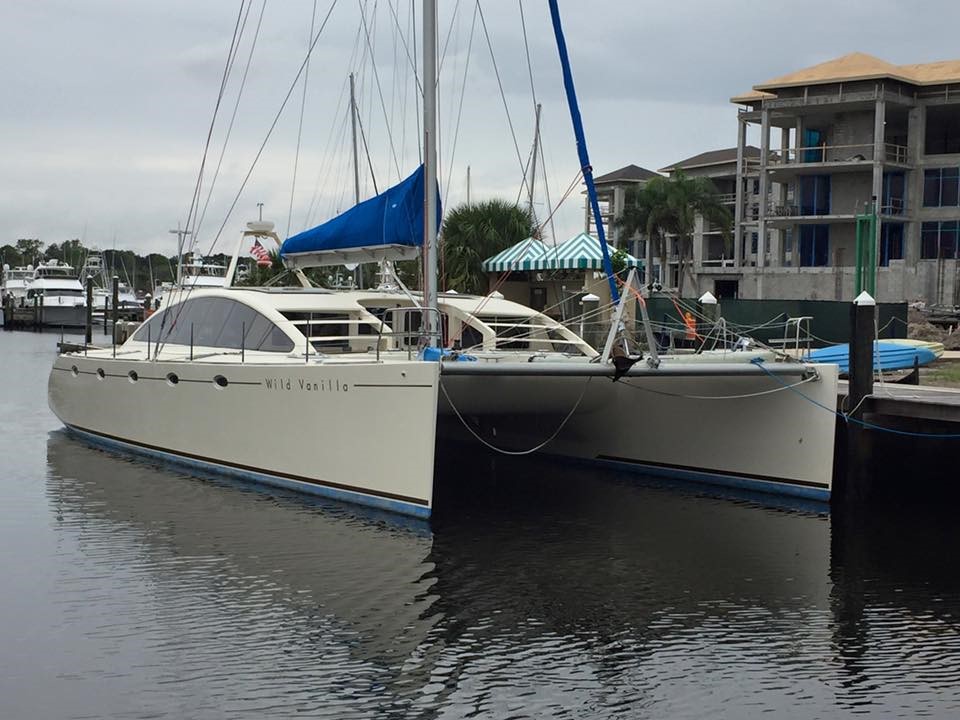
First, for those who don't know what these boats look like when complete, here is a photo of the prototype of the DH550 design, "Wild Vanilla". Building the DH550 kit will duplicate this boat and building the Dix 470 kit will produce a smaller sister of identical aesthetic. These are stunningly beautiful boats, among the prettiest catamarans currently available and they can also be built by any competent woodworker.

The DH550 "Wild Vanilla", co-designed by Dudley Dix and Phil Harvey.
Exocetus Yachts did all of the development work for the kits that they are cutting and selling. In the process they have done a tremendous amount of 3D computer modeling to define every piece of plywood that goes into the boat, including every jigsaw joint that connects one piece to another.

They have also broken down the assembly process into the many phases of work that turn a pile of plywood bits into a beautiful yacht. Each of those phases is illustrated in an interactive PDF file that can be opened in Acrobat Reader and shows the boat in a 3D image that can be manipulated on the screen in multiple ways. You are able to rotate it and zoom in to whatever level you want, to see from a broad overview right through to the details of a joint. You can also change the mode of presentation of the image, including rendered and see-through views or to see it as a perspective inked drawing. Different view choices highlight different details of the presented information.

The images below are for Phase 37, fitting the port hull bottom. The bulkheads have all been assembled, set up on the building stocks (which are also part of the kit), the backbone has been installed and the stringers fitted into their pre-cut slots in the bulkheads. This work was all shown in phases 1 to 36.
Broad overview of Phase 37
Zoomed in to see the aft bulkheads, including their jigsaw joints.
Rotated to see the other side of the structure. Here you can see the horns for bonding to the bridgedeck bulkheads.
The same view but set to show as a drawing.
Zoomed in to see details of building stocks, intersections of structure etc.
Same view but in a rendered mode. You view it in the way that will help you most.
This is a very powerful tool for the builder. He can look at any part of the structure to analyse it and understand how it goes together before or during the process. It takes a very large project and breaks it down into much more manageable and understandable stages, removing the confusion that can accompany any complex undertaking. It tells you exactly where and how to start, then guides you all the way through the process until you are ready to launch your new boat.

To see our full range of designs, please go to our main website or our mobile website.

Tuesday, February 23, 2016

Didi 40cr in the Rocky Mountains

Bill Connor and his family have been causing quite a stir in the suburbs of Boulder, Colorado, snow-skiing mecca in the Rocky Mountains. The neighbours have also been rallying around their project, a 40ft cruiser/racer sailboat to our Didi 40cr design. Few people expect to see a mast like his sticking up from among the houses and trees so far from the ocean. Now they are getting close to launch date and are making plans to move their new boat, "Alizée", to her ocean environment. She will be trucked the 2000 miles to Mystic in Connecticut, where she will be launched and do her sea trials, before being exhibited at the Wooden Boat Show at Mystic Seaport the last weekend of June.
"Alizée" on her trailer, being readied for her long road trip.
I have only seen her in photos and those show that "Alizée" has been built to a very nice standard. Her finishes are high quality and they have been very tastefully done. Despite the distance of their home and building site from the ocean, the Connor family are not strangers to sailing and the oceans, they are experienced boat owners and offshore sailors in their previous boats. This time Bill wanted to create his own custom performance boat rather than buying a stock production boat.

This pic shows the very high standard of finish, not your average amateur project.
Looking forward from the galley. Simply gorgeous. Easy handholds for rough water.
Nicely appointed sea-going galley, snug, practical and everything accessible.
This was the start, with son Spencer helping to fit the keel.
This is the bigger sister to "Black Cat" but finished to a much higher standard than the basic lightweight racing finish that I used when building her. Bill has shown just how beautifully a boat like this can be finished. Come and see her at Mystic Seaport, at the Wooden Boat Show 24-26 June. We will be there as well, so you can speak to us about this and other designs at our booth in the main tent.

To see more of this and our other designs, visit our desktop website or our mobile website.

Sunday, January 31, 2016

Didi Cruise-Mini Across the Atlantic

Tony Hussey built himself a radius chine plywood Didi Cruise-Mini in the UK. We have exchanged communications recently, while he has been en-route from UK to the Caribbean in his little boat. This is a cruising version of the little Didi Mini trans-Atlantic raceboat, so it is in its proper element with a cruise like this.

Tony has said that he is very happy with his little cruiser. He sailed her from UK to Spain and back in 2014. Then last year he sailed UK to the Azores and has now continued to Antigua.

From the Azores Tony wrote "Im not pushing the boat as I'm cruising and can't afford any breakages. I also slow down at night to 5 kts to help sleep. My autopilot doesn't handle the spinnakers very well so can't make good use of the higher speeds but the light wind performance with the big spinnakers is amazing for a small boat. On a beam reach in 6/8 knots apparent I'm up to 6 kts boat speed keeping up with the bigger cruisers motoring with not enough wind. Top speed so far is 12.9 but around 12 I chicken out as I can't trust my autopilot to control the boat when I take down the spinnaker."

Now that he is in Antigua and recovering from a back injury he wrote "So far I've done over 8000 miles singlehanded in the boat and very happy with it, always felt safe but never dry!! Joke. The plan is Panama this summer then out towards Australia through Polynesia."

The Didi Cruise-Mini has the same hull and deck as the Didi Mini but with a bit more headroom, more comfort and a more compact sail plan.
Under sail with big squartop mainsail and Solent jib.
At anchor in the Azores.
"Splinter" - Great name for a small wooden boat.
Seagull's view of a beamy little cruiser.
Hitching a tow from a kayak due to outboard problems.
We wish Tony and "Splinter" happy cruising, looks like they are angling toward a circumnavigation. You can follow their adventures on Tony's blog.

To see more about our designs visit http://dixdesign.com/ or http://dixdesign.com/mobile

Thursday, January 28, 2016

Didi 950 Australia Project Update

Yesterday I wrote about the Didi 950 of Mike Vermeersch in Ohio, today is the turn for the parallel Didi 950 project of Fred Grimminck in Australia.

Fred is building his lifting keel version from scratch, using plans and offsets. He has been progressing very quickly and should be launching within a few months. His boat is destined for fast cruising rather than racing, so he is fitting her out for comfort rather than attempting to get close to class weight.

The lifting keel foil and bulb use similar details to the fixed keel except that it has no flare and root plate at the top and extends through a steel casing into the hull, where it bolts down onto the top flange of the casing. This is right where the engine is in the fixed keel version, so Fred's motor moves to under the companion ladder and is fitted with a saildrive instead of a shaft with stern tube.

Fred has made some changes from the design, so these photos show some differences from my drawings. Among the changes are encasing the lifting keel casing and mechanism all the way up to the deck and swapping the layout from aft heads and forward sleeping cabin to forward heads and additional aft sleeping cabin.

Casing for lifting keel being installed. Galley locker will surround it.
 
Water ballast tanks and double quarter berth on port side.
Galley.

Port water ballast tanks and double quarter berth, looking through into lazarette.
Navigation station.
Looking from nav station, through saloon into forecabin, in this case with forward heads.
Companion ladder to cockpit. The motor is behind the ladder.
Cockpit and cabin.
Deck and cabin nearing completion.
Casting half of the lead ballast bulb.
The next update on Fred's Didi 950 will likely be when he launches her.

To see our full range of designs, please visit http://dixdesign.com/ or http://dixdesign.com/mobile


Wednesday, January 27, 2016

Didi 950 Ohio Project Update

It has been awhile since I last updated about the Didi 950 amateur builds happening on opposite sides of the world. I was reminded last week by a reader that there are folks out there waiting to see more.

Both boats are progressing at a good rate and both should be launched this year. The boat of Fred Grimminck in Australia, the lifting keel version built from scratch, is nearly complete and should be launched in a few months. Mike Vermeersch in USA hopes to launch his fixed keel version, built from a kit that we supplied, on the Great Lakes in the summer.

Both are building their boats primarily for cruising, so are fitting them out for comfort more than trying to achieve minimum weight. In this post I will include photos of Mike's fixed keel boat and my next post will feature Fred's lifting keel boat.

I wrote last year about Mike's keel that was being built by Howdy Bailey. It was in progress at the time so I didn't include pics of the completed keel, which are shown in these photos.

Pre-formed side plate being plug-welded to the internal tube structure.

Ballast bulb ready for fitting to keel foil.
Keel and bulb mated, faired and primed, ready to be shipped to the builder.
The keel will be bolted to a substantial steel weldment that is inside the hull and bolted to glass-reinforced eggcrate backbones and bulkheads, with the hull skin (also glass-reinforced) sandwiched between the top of the keel and the internal steelwork. That steel weldment does double-duty, serving also as the engine beds.
Engine beds snug between the longitudinal and transverse structural members.
Engine mounted on beds. The keel bolt holes can be seen under the engine.
The engine of this version is located under the galley central counter. It will have large access panels all round for engine work and for access to the keel bolts. Some people object to this engine location, saying that the motor is too smelly to put in the middle of the accommodation. Not so, all of my personal boats have had the motors in this position and I would not want it anywhere else. It makes the engine easy to work on and to keep clean, giving a boat that always smells fresh. A big reason why under-cockpit motors are smelly is that they are so difficult to work on and clean that they tend to be neglected. This location also places the motor close to the centre of pitching, so is good for performance in lumpy water.
U-shape galley being built. The engine is under the counter on the right, cooker to the left.
Epoxy-coated plywood icebox.
Icebox installed and foam insulation poured, ready for trimming.
The rest of the interior is also progressing.
Saloon, looking forward. As designed the settees are water tanks but Mike is installing plastic tanks elsewhere.
Looking down at the top of a water ballast tank, with watertight access covers.
Mike is doing a very neat build. This is partly due to building from a pre-cut kit but most of it is due to him having very neat working habits. I consider my own woodworking to be neat but Mike makes my work look a bit tatty in comparison. It is always worthwhile to keep the build area free of scraps, shavings, dust, tools etc for the sake of safety but also to make it easier to work with glue, epoxy coatings, paint etc without messing up both the tools and your workmanship.
 
An important aspect that many builders ignore is to round off all salient corners, whether they will be seen or not. It only needs a minute or two to run each timber through a router with 6mm radius bit, leaving soft corners that hold coatings well and won't damage your hands, knees and feet. Neglect this step and you will have an interior that looks amateurish and will also damage you when you fall against it. This small detail will make the world of difference to the final look of your new boat, helping to make it something of which you can justifiable be proud. 


Watch for my next post in a day or two to see Fred's lifting keel Didi 950.

To see our full range of designs, please go to http://dixdesign.com/ on your computer or to http://dixdesign.com/mobile on your mobile.