Showing posts with label Plywood catamaran. Show all posts

Wednesday, July 17, 2019

DH550 Catamaran "Valerie"

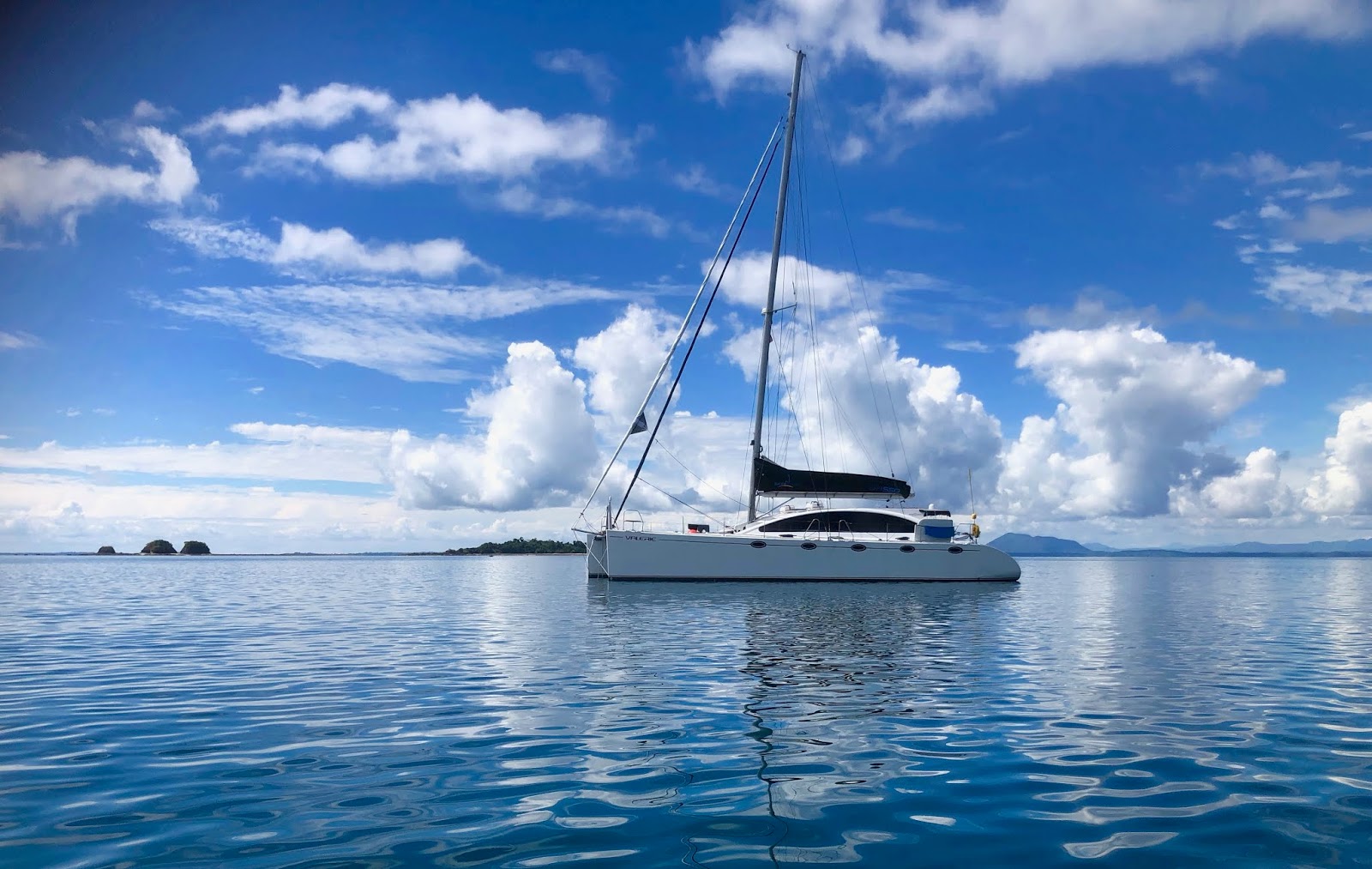
"Valerie" is the newest DH550 catamaran, launched in Durban, South Africa, a few months ago. Now she is in the Seychelles, awaiting her charter licence. Within a few weeks she should be licensed and available for crewed charter among these gorgeous Indian Ocean islands.

DH550 "Valerie" relaxing in an idyllic setting.
"Valerie" with Argie 15 as yacht tender.

A closer view.
Starboard aft cabin.
Galley on port side of saloon.
Settee on starboard side of saloon.
Inside helm and nav station.
Fast, comfortable sailing.
"Valerie" was built from a kit from Exocetus Marine in UK, who supplied a fairly comprehensive kit. It included CNC-cut components for hull, deck, bulkheads and interior joinery, as well as deck hardware, machinery, electrics and many other items.

"Valerie" will have a website in a few months. Until then I can forward any enquiries about chartering her to her owners.

To see our full range of designs go to our main website or our mobile website.

Thursday, January 24, 2019

Dix 430 Catamaran

A long time ago I drew the basics of a design for a 43ft wood/epoxy catamaran for a professional builder. He didn't have the resources to build the boat, so the design went no further. Ever since it has remained on our website as a teaser, hoping to entice another builder to commission the completion of the design. A few people did ask me to carry on but those requests somehow never coincided with a gap in my design schedule, so it went no further.

I did get to design the bigger Dix 470 and DH550 cats for radius chine plywood construction. A few of the 55 footers have been launched and others are in build to both designs. Both boats are also offered as comprehensive CNC-cut kits of all plywood components, by Exocetus Marine in UK.

Exocetus Marine wanted to expand their kit range down to smaller cats as well, so they commissioned a new 43ft cat with a similar aesthetic to the bigger boats. This has replaced the design that has been languishing on our web pages for so long. Exocetus Marine will have the programming for cutting the Dix 430 completed during the second quarter of this year.
Dix 430 sail plan
As with the bigger sisters, the new design is also radius chine plywood construction, the build method that I developed for my Didi 38 prototype "Black Cat". That boat is now 23 years old and is still racing competitive. That design has been followed by a stream of smaller and larger designs of similar or derivative construction.

In addition to the kit option, the Dix 430 can also be built from plans or from plans plus Mylar bulkhead patterns. They can be ordered through our stock plan pricelist.

The new boat is a good size for family distance cruising and lazing around the islands. Initially available with cruising keels, a daggerboard option may be added later if there is demand for it.
Dix 430 accommodation
Dix 430 cross-section
See more of this and our other designs on our main website or our mobile website.

Monday, November 5, 2018

Bigger Sister to Oppikat Catamaran

Following on my last post, about the new build options for the Oppikat, a customer has commissioned a bigger sister. Over the years many people have asked if we had a bigger cat for them to build. They wanted a boat that could be sailed by two adults rather than by children or by one adult with a small child. So, now we have the Bigakat 12. The first boat will be built in Nassau, Bahamas, from plans and patterns. The drawings have been completed and are already on their way to the amateur builder.

The Bigakat 12 is in every respect a bigger sister to the Oppikat. The build methods are the same, with plywood upper hull panels and strip cedar below, over plywood bulkheads. Only the size and proportions have changed and some minor details.

While working on this project I took the extra time to add more drawings to the set than we have in the Oppikat design. The additional detailing helps builders to better understand the construction details and process of assembly. Better understanding improves confidence and building speed.
Biggakat 12 sail plan.


Specifications of the Bigakat 12 are:-

LOA - 3.72m (12'2")
LWL - 3.72m (12'2")
Beam - 2.10m (6'10")
Draft - 0.27m (10.5")
Mainsail - 7.83sq.m (84sq.ft)
Jib - 2.5sq.m (27sq.ft)

The standard plan package for the Bigakat 12 includes full-size patterns for all bulkheads, printed overlaid on top of each other. As an optional extra we can also supply full-size patterns on paper for the bulkheads each set out separately, along with patterns for the plywood panels of hull and deck. This allows the builder to cut out the bulkhead shapes to paste them onto plywood for cutting.

We also have detailing to build the Bigakat 12 in fibreglass, laminated in female moulds. This version is primarily for pro boatbuilders to build in series. We don't currently have any GRP builders producing the Oppikat and Bigakat 12 but would be interested in discussing this with any pro boatbuilder who is interested.

Plans for this design and all of our other designs can be ordered from our desktop pricelist or our mobile pricelist.

To see all of our designs, go to our desktop website or our mobile website.


Thursday, October 25, 2018

Oppikat Junior Catamaran News

There is a lot of interest in our junior catamaran design, the 9ft Oppikat. It is built from a combination of cedar strip for the compound curved surfaces and plywood for bulkheads and flat surfaces. Some amateur builders have produced exquisite examples, showing beautiful craftsmanship that highlights their skills.
This Oppikat was built by Pavel Arzhevitin to a gorgeous standard.
We all have our own ideas about finishes, hardware layouts etc. so what one builder does to suit their own intentions for their boat will be different from another. That is part of the attraction of amateur boatbuilding, producing one-off craft that exactly suit our own needs.

The Oppikat was intended essentially as a boat for junior sailors, to have a boat of their own that has a good turn of speed and can give exciting sailing before moving up to bigger and more challenging boats. But time has shown that these little boats aren't only sailed by their intended lightweight skippers. The Oppikat has high-volume hulls for safety and fathers have sailed them, both by themselves and with junior.
Oppikat built by Frank Nagel, with his son sailing.
Oppikat can be built from plans only, which include full-size patterns of bulkheads and transom. Now we have added another two build options.

1) Build from plans and pre-cut bulkheads, cut by CNC router.

2) Build from plans and a wood parts kit that includes all plywood components, pre-cut by CNC router, plus bead and cove strips for the lower parts of the hulls and timber for all of the framing in the hulls.

These are available in USA but may be expanded to suppliers in other countries if requested. For USA buyers, go to our plywood kits pages for either computer or mobile devices.

I have also been asked numerous times over the years to draw a slightly bigger sister that can carry an adult or two. That is now on the drawing board and should be available in a week or two. Watch this blog for future news.

To see our full range of designs, go to our main website or our mobile website.

Friday, August 17, 2018

Update on 50ft Catamaran in North Carolina

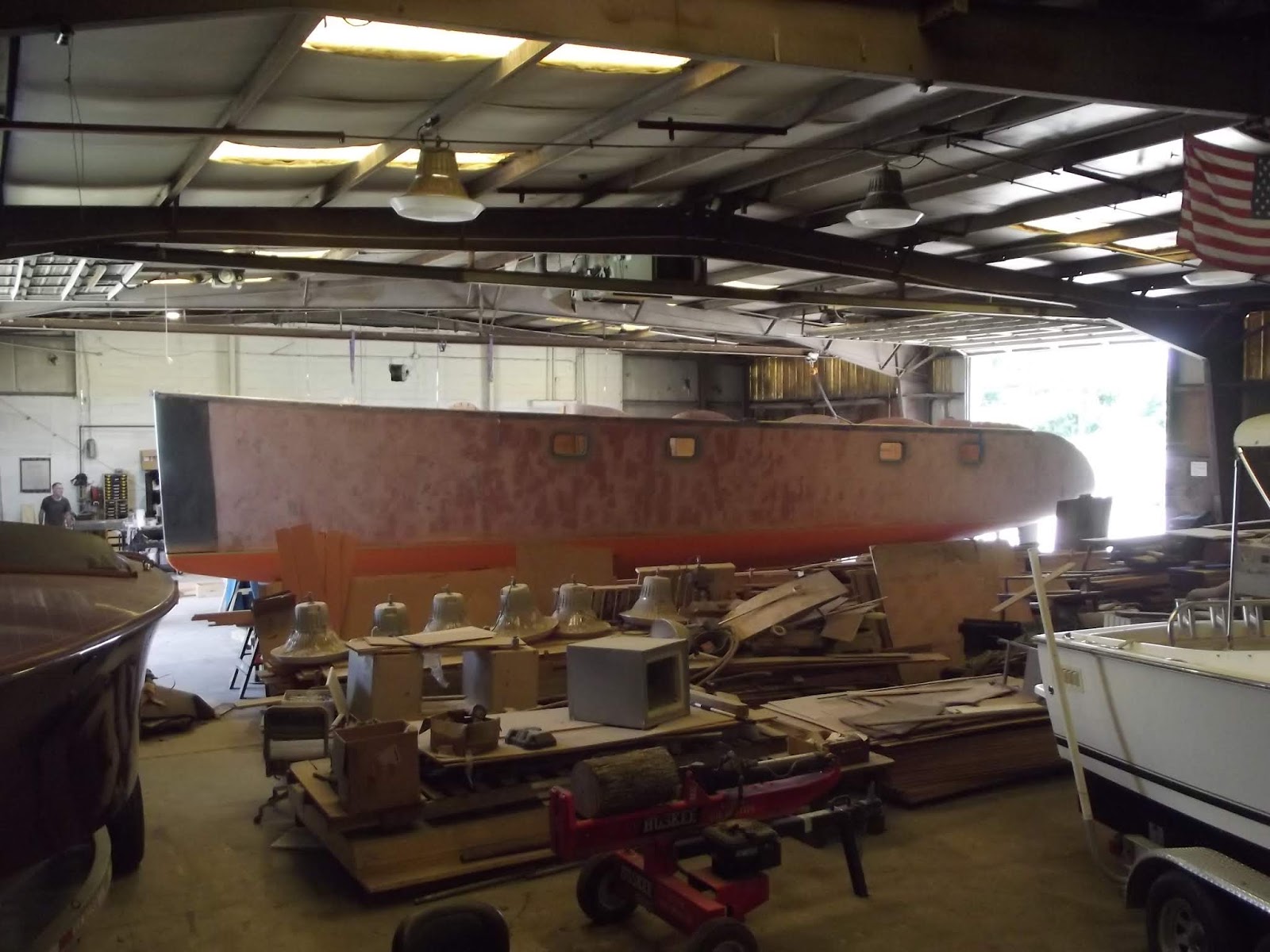
I visited the 50ft catamaran build by CRW-Con in Edenton, North Carolina last week. The first hull has been turned over and work has started on the second hull. The photos and captions tell the story.
Outboard view of the port hull. The hull has been sheathed with a layer of 1708 glass, then faired.
Inboard view of the starboard hull. The bulkhead horns projecting from the hull are for scarphing to the bridgedeck bulkheads.
Bow view. To the right is the long spar table for scarphing timbers into the hull-lengths needed to install in one piece.
Stern view, with the boarding steps taking shape. Rudder and P-bracket already installed.
Bulkheads being set up on the stocks for the starboard hull
View looking forward inside the hull.
Looking aft.
Cruising keel.
Composite chainplate being formed on plywood panel. This is the first panel that will be fitted onto the hull framing, then the others will be fitted working toward bow and stern. 
Close-up of the incomplete composite chainplate. The carbon spreads the loads down into the hull skin and structure and the shrouds are attached in the gaps with soft lashings. 
Faired-in opening for flush-fitting porthole.
Formed opening for flush-fitting escape hatch, The boxing over it is part of the 45 degree splayed panel that will connect the underside of the bridgedeck with the inboard hull side.
This boat is a modified version of out Dix 470 radius chine plywood catamaran design, stretched to 50ft. Both are sisters to the DH550.

To see our full range of designs go to our main website or our mobile website.

Wednesday, July 25, 2018

50ft Catamaran Build in North Carolina

There is a custom sister to our radius chine plywood catamarans taking shape alongside Albemarle Sound in Edenton, North Carolina. The builder is CRW-Con and the build method is composite reinforced wood construction, adapted by the builder from our radius chine plywood method. The base design is our Dix 470, expanded longitudinally to 50ft. The 470 is the second in our catamaran range that started with the DH550.

This series of photos shows construction of the first hull, which will be turned over in the next week or two.
Bulkheads and backbone set up, with stringers fitted into bulkhead slots.
First layer of radius skin fitted, foam fitted between stringers and keel structure in progress.
Plywood outer skin being fitted to sides. The opening is for the escape hatch.
Side skin completed, keel completed and glassed.
Glasswork completed.
Fairing with Awlfair.
This first boat has cruising keels and is being built on spec, with the builder seeking a customer for it. Interior configuration and finishes can be agreed between owner and builder if a buyer commits to the boat before the builder gets to a stage where he has to make those decisions. Anyone interested can email me, then I will put them in contact with the builder.

This design is not on our website. To see our range of available designs go to our main website or our mobile website.

Wednesday, July 18, 2018

DH550 Catamaran Video

Today I saw a rather nice walk-through video of the DH550 "Cheetah", posted by Wiley Sharp. This boat was custom-built for her owner by Peter Lane in Trinidad, to a gorgeous standard. She has beautiful veneered finishes throughout, unusual for multihulls. Click on the link to watch the video.
The layout of "Cheetah" is a bit different from our standard layout, modified by her architect owner to suit his needs. The normal arrangement is four equal cabins, two in each hull with a large shared heads with shower between the two.

The other big difference between "Cheetah" and the other boats built to the DH550 design is in the powering. "Cheetah" has a pair of electric drives powered by large battery banks charged by solar panels backed up by a diesel generator. Each of the other boats has a pair of 50hp diesel motors.
DH550 "Cheetah" on launch day.
"Cheetah" and most of the other boats have daggerboards but the design includes a cruising keel option, as fitted to "Friends Forever". The drawings also show the option of dual steering, one inside the saloon as used on "Cheetah", and the other in the forward cockpit. The two wheels share a common shaft that passes through the bulkhead that separates the two.
DH550 "Friends Forever" under sail.
Cheetah was built from scratch, using plans only. There is a company in UK, Exocetus Marine, that has developed a very comprehensive CNC kit that includes all plywood components that go into the boat, to speed up construction of amateur and professional projects. Boats are being built in Australia, Germany and South Africa using their kits.
DH550 being built from an Exocetus kit in South Africa.
More recently we have introduced the DH550 Charter, with interior layout more suited to charter service, as well as aft elevated cockpit for helming and all sail handling.

See more info on these and our other designs on our main website or our mobile website.

Tuesday, April 17, 2018

DH550 Charter Catamaran

The DH550 catamaran has been or is being built in the Caribbean, Europe, Africa and Australia. All of these builds have been to the original design, as drawn for Phil and Laura Harvey to build the prototype "Wild Vanilla" as a family cruiser.
"Wild Vanilla", now renamed "Taika" under her new owner
We now have a new version of the DH550 , named the DH550 Charter. It was commissioned by a charter company and construction will start in the next few weeks. It has features that are better suited to charter service, in the cabins, bridgedeck accommodations and rig.

This version has four equal double guest cabins, each with en-suite heads and shower. There is also a compact single crew cabin in the bows of each hull and a shared crew heads with shower in the starboard hull.

More space has been given over to life outside, so the bridgedeck accommodation has a smaller saloon and larger cockpit than the cruising version. It has two galleys, one internal and the other in the cockpit. The forward cockpit, a working area in the cruising version, is changed to a social area with seating and folding table. The working cockpit has moved aft to above the outside galley, with helm and engine controls. All sail control lines, except halliard and reefing lines, are led to a pair of electric winches mounted on the cabin roof. This cockpit has large cave lockers to keep the ropes tidy and out from underfoot.
DH550 Charter accommodation
The rig commissioned by my client has in-mast furling for easy handling. It has vertical battens to support modest roach.The boom has been raised for better clearance over the working cockpit. It has also been lengthened to regain some of the lost sail area and to move the sheet further aft to where it won't conflict with the working cockpit. A pair of posts has been added in the cockpit to pick up the loads applied to the cockpit roof by the mainsheet.
DH550 Charter rig with in-mast furling and vertical battens.
I also drew an alternative charter rig with slab reefing instead of in-mast furling. It regains area by means of more roach

Aesthetically, the charter and cruising versions are little different. The working cockpit is fairly inconspicuous, so doesn't spoil the clean lines of the cabin.

This version is only offered with cruising keels, for simplicity of operation. Lack of the daggerboard casings also gives more freedom for fitting in the required accommodation in the forward guest cabins.

The two steering stations are separate, connected only at the tillers on the rudder shafts, giving 100% redundancy. In the event of breaking a steering cable, the boat can still be steered at the other helm.

To see more of this and our other designs, go to our main website or our mobile website.
Wednesday, November 8, 2017

Updates on the DH550 Catamarans

Last year the DH550 "Friends Forever", built by JJ Provoyer and his team, was launched in Cape Town, South Africa. For a few months "Friends Forever" day-sailed locally, then set off trans-Atlantic (South Atlantic) to cruise the Caribbean. Then back across the Atlantic again (North Atlantic this time), headed for the Med, final destination Israel. Last that I heard she was cruising France.
DH550 "Friends Forever" on Table Bay.
Easy sailing in beautiful conditions.
While "Friends Forever" was in France, she was visited by Kevin Bream of Exocetus Marine, supplier of CNC kits for the DH550, Dix 470 and the Dix 430 (currently in the design phase). Kevin did a drone fly-around video and sent some photos and a sailing report. He said "We went for a sail for one day. We were on a close haul tacking out from Cogolin past Saint Tropez, and making better speed than all the mono hulls, tacking speed was impressive as well. Overall very impressed."
"Friends Forever" sailing off St Tropez.
Back in South Africa, Sea Tribe Catamarans is building a DH550 in Durban. They are building from a kit supplied by Exocetus Marine and are moving at a fast pace. They have a series of time-lapse videos of their project on the Sea Tribe blog, showing the build process. I wrote earlier this year about the kit that was shipped to Southern Africa.
Sea Tribe turning one of the hulls of their DH550.
To see more about this and our other designs, go to our main website or our mobile website.

Friday, March 17, 2017

DH550 Kit Shipped to Southern Africa

Exocetus Yachts has shipped another kit for the DH550 sailing catamaran, this one to a builder in Southern Africa. This was more than a CNC plywood kit, it included many extras in the form of equipment and materials for the boat. The total package needed a 40ft container to keep it all together. The photos below show the order during loading. Exocetus is able to customize their kits to suit any builder, from a partial plywood CNC kit through to almost everything needed to build the boat.
"Wild Vanilla", prototype of the DH550 design. This is what the completed boat will look like.
Some of the components of the building stocks.
Pre-formed plywood panels for the hull radius.
Plywood and more plywood, CNC-cut and clearly referenced for assembly.
On top are timbers for stringers and other structural members.
Generators and engines. Behind them, porthole frames, also cut with CNC equipment.
Hardware, plumbing, electrical and other equipment.
Epoxies, tanks and more equipment
Container packed and ready to be closed and sealed.
Container loaded and heading for the ship.
To see more of this and our other designs, go to our main website or our mobile website.