Showing posts with label ocean capsize. Show all posts

Tuesday, October 23, 2018

South Atlantic Capsize e-Book

Ever since I published the paperback version of my book, "SOUTH ATLANTIC CAPSIZE - Lessons Taught by a Big Ocean Wave", readers have asked for a digital version to read on their computers or e-readers. I have finally got around to doing that. We can now offer this book as a PDF file to view on a computer or EPUB to view on readers that use that format.
Cover image.
I have included an extra chapter, in the form of an article that I wrote for the magazine of National Sea Rescue Institute of South Africa, at the request of the CEO of that organisation, Dr Cleeve Robertson. He was concerned about how many people were perishing in boat capsizes around the coast of South Africa and elsewhere. It details the many dangers that impede anyone trapped in or under an upturned boat and advises on those dangers and what route and steps to take for the best chance of surviving the deadly situation. We will also include a copy of the article with future sales of the paperback version of the book.

To buy a paper or digital copy of this book, go to the Published Books page on our main website or our mobile website.

Friday, September 18, 2015

Review of South Atlantic Capsize Book

The first review of my book "South Atlantic Capsize - Lessons Taught by a Big Ocean Wave", has appeared. This review was written by Richard Crockett, editor of Sailing for Southern Africa magazine. I will leave the review to speak for itself.

Front cover of the book.
More Really Good Books
 
One of the perks of my job is that I do get to read some really good books. Two I have recently read got into that ‘must read’ category.


The first is entitled ‘South Atlantic Capsize’ – Lessons Taught by a Big Ocean Wave.
 
It is written by Dudley Dix and tells the story of ‘Black Cat’, the crew, the 2014 Cape to Rio Race and the storm that struck the fleet in the opening days of that race. It’s a personal account of what happened on the boat when it was capsized, what damage was done, what the men onboard did to safeguard vessel and crew, what they did to get themselves back to port – as well as what else was going on around them.


It’s rivetting reading as it is not just well written, but written by a man with a serious understanding of the sea, yacht design, yacht construction – and ultimately what happened to them out there.

I like the fact that it gives some history of the Cape to Rio Race, a pretty detailed account of the boat’s design and construction and his careful selection of crew. To many crew selection is simply a case of asking mates, but for Dix it’s far more than that.

So, for anyone contemplating competing in the 2017 Cape to Rio race, this book should be read, not for the scarey stuff, but for the practical preparation tips, and advice on handling bad weather. For those simply making passages at sea, there is lots to learn too.

Thank you Richard Crockett for the review.

To buy the book or to view our boat designs, go to http://dixdesign.com/.

Tuesday, May 19, 2015

South Atlantic Capsize

Most of you will have read here or elsewhere about our adventure in the 2014 Cape to Rio Race on the Didi 38 "Black Cat". I have published a book about it, which can now be ordered from our website. For those who don't know what happened, here is a synopsis of the book, which is titled "South Atlantic Capsize - Lessons Taught by a Big Ocean Wave".

At dusk on 5th January 2014, the Didi 38 "Black Cat" was struck by a massive wave on the second day of the 2014 Cape to Rio Race across the South Atlantic Ocean. The wave capsized her in an instant, flinging crew, equipment and food around the interior and destroying most of the electronics with water that entered through the companion hatch. "Black Cat" recovered very quickly but the electrical damage was done. This is the story about the race, the boat, the crew and what happened on that day.
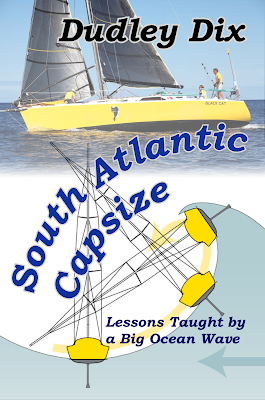
Front cover of the new book
It also explains the principles of stability that control the safety of monohull sailboats, mostly those characteristics that affect the behaviour of boats in large beam seas that might capsize them and the features needed to quickly return them to upright. It does this in words and terms that can be easily understood by non-technical people.
Back cover.
You will also read the story of the capsize of the 64ft "Sayula II" in the Southern Ocean when sailing between Cape Town and Sydney in the 1973 Whitbread Round the World Race, written by yacht designer Butch Dalrymple-Smith, who was one of the crew. Also what one boat owner has added to his own boat to prepare it and himself in case they are caught by conditions that place them at risk of capsize.

I managed to coerce two of the crew to also put pen to paper, to each write a short piece about his experience. I felt this to be important because we all observe events from our particular points of observation and positions in life. My view from the inverted cabin roof of Sean Collins hanging on for his life in the cockpit and of Adrian Pearson flying like a rag doll around the cabin is very different from that of Sean looking down the steep slope of a monster wave and seeing the masthead spearing into the ocean below, knowing that the boat will follow deck-first.  I would have liked to have had stories from the other two crew as well but they did not feel capable of effectively putting their stories into words.

You can buy the book at http://dixdesign.com/articles.htm. We can ship to you wherever you are, at our normal shipping rates.

To view our range of boat designs, please visit http://dixdesign.com/

Thursday, March 5, 2015

Yachting Monthly Capsize Video

Yachting Monthly have a very interesting  video of a capsize test on their YouTube Channel. I only became aware of it yesterday when it was highlighted by Scuttlebutt Sailing News.

Many have read the accounts that I have written about our capsize experience on the Didi 38 "Black Cat" in the Cape To Rio Race 2014. It is not possible to visualise what it is like to be there in that situation, even if you sit inside your boat and try to imagine it turning around you but this video goes a long way to help visualise it. It is not fully realistic because the roof stays at the top as the boat rotates, so the world is rotating around the boat rather than the boat rotating within the world around it. To provide better visualisation the camera needs to stay upright while the boat goes upside-down.

Bear in mind that this test is in flat water and the boat is rotated quite slowly from upright to upside-down, then rights itself quickly. Normally a capsize will happen in seas that are large and confused, so it is a much more violent process than seen in the video, with the boat being thrown in confused directions while it capsizes. Despite that, it is worth watching, to see the way that crew, equipment, etc was moved around the cabin and to see just how much water came in even in that still water.

It is not an experience that I would recommend to anyone, yet it is an experience that I am glad to have had and to have survived.

It also validates the toughness of the methods of construction that I have used for these plywood designs, that "Black Cat" came through with minimal damage.

To see our range of designs to carry you across the dam or around the world, please visit http://dixdesign.com/