Thursday, December 29, 2016

"Black Cat" in Cape to Rio 2017

I was to be co-skipper of "Black Cat" for this race, the 2017 iteration of the wonderful Cape to Rio Race, linking two beautiful cities that are separated by the South Atlantic Ocean. "Black Cat" is the Didi 38 that I built in my garden for the 1996 race. That plan to co-skipper her, partnered by Dave "Wavy" Immelman, came off track when I wrenched my already-damaged left knee while racing my Paper Jet skiff in Maryland a couple of months ago. When I got off my boat I could hardly stand and subsequent visits to doctors, followed by X-Rays, MRI etc. came up with sheer tears in both menisci of the knee. Able to only hobble around, surgery was scheduled and I felt that I would be a liability and danger to boat, crew and myself for the race. Sadly, I had to withdraw from the crew and will miss this race that I so enjoy.

I will still be involved though. "Black Cat" has satellite telephones aboard and they will be used to send me daily reports from the boat, with news about life aboard, how the race is going and anything else that is happening. They will also send me photos and possibly video footage as well. I will use that as material for posts on this blog.
"Black Cat" crossing the finish line of the 2014 Governor's Cup ocean race from South Africa to St Helena Island. Skipper Dave "Wavy" Immelman standing at the helm.
The race starts on Sunday 1st January at 14h00 local time, 12h00 GMT. The slower boats have already started their race, on Boxing Day (26th December). These are IRC Division 3 monohulls and Division 2 multihulls. Progress of the race can be followed via live tracking on XTra-Trak. This link works in Internet Explorer but doesn't seem to work properly in Google Chrome.

This is supposed to be a downwind race, with spinnakers hoisted in Table Bay and dropped off Guanabara Bay a few weeks later. I have raced in it four times and each time was very different from the others. Downwind conditions are not guaranteed. Storms along the way are almost a certainty, as evidenced by our capsize in the 2014 event. Hard racing, lots of fun and wonderful experiences that stay for a lifetime are a feature of this race, making close friendships that last for a lifetime. Close quarter living in such a small space brings out the best in people but it can also bring out the worst, so at the finish there will be a few people who will step off their boats and never want to see others in that crew again.
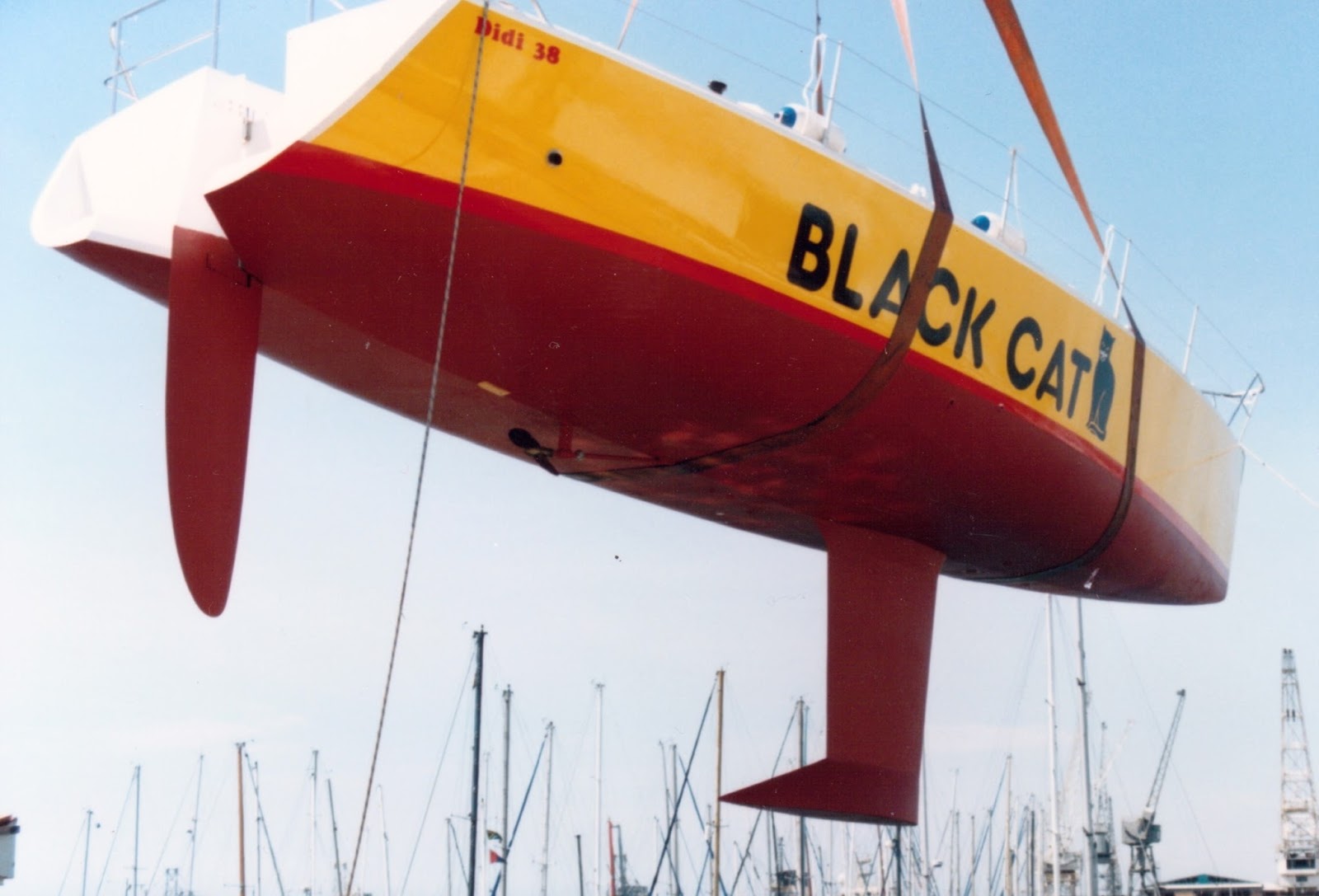
The launch of "Black Cat" 20 years ago.
I wish skipper Dave Immelman and his crew all the best for the race. I wish them great sailing, great results and, most of all, great friendships.

Friday, December 16, 2016

Argie 15 Framing

It has been pretty cold here the past few days, with winter starting to bite. Today the high temperature was just on freezing. As it grows colder over the next few weeks, a snug workshop is a good place to be spending productive time.

Kevin Agee is spending most evenings in his workshop, working on the Argie 15. Current tasks are fitting the framing for the seats and the transom doubler.

If you are fortunate enough to source timber longer than the hull, you can do the side stringers each in a single length. For the rest of us, it is necessary to join two pieces together to get the full length. This is done by scarphing (or scarfing or scarph-jointing) them. Each joint is done by cutting or planing the ends to be joined at an angle to form sloping mating surfaces. For an application like this and using modern adhesives, the slope angle need not be more than 1:6, so for timber 20mm thick the joint would be 120mm long.
One half of the scarph joint. This was cut on a saw but it could also be done with a jack plane.
The two pieces to be joined, dry-fitted to check accuracy.
The joint has been glued and here is shown being glued into the hull with temporary screws to hold the stringer until the glue has cured.
Stringers are glued in along both sides to form landings for the seats against the hull sides. Edge frames are also glued to the bulkheads to support the transverse seat edges.
Stringers fitted full length of both sides to form landings for the seats.
Edge framing being glued in for transverse seats.
Working neatly all the time will ensure a good finished product. This joint is an example, no scrappy edges, nicely filleted internal angle, all contact surfaces glued for a solid joint. 
View into the structure at the stern. The extra plywood layer on the centre of the transom is a doubler to strengthen it for the rudder pintle fittings. The notches in the tops of the transverse frames are for half-jointing the seat stiffeners. Those will be added in a future post.
You can see in all of these photos just how neat Kevin's work is. This is important if you are to have a really nice boat at the end of the project. If you don't think that you can't work to this standard, consider that Kevin is an amateur boatbuilder, not a professional. He is working with normal hobbyist woodworking tools. He has only built one previous boat, his own Inlet Runner 16.

To see more of our designs, go to our main website, our mobile website or our Flickr albums.

Monday, December 12, 2016

Plastics in Our Oceans

I read a very disturbing article in the monthly newsletter, "Talking Sailing",  of Richard Crockett, editor of Sailing for Southern Africa magazine. The article was authored by Lily Bovim, who has a BSc in Marine Biology and Oceanography and an Honours degree in Biology, both from UCT (University of Cape Town).
 
The invention of plastics has been one of the most wonderful and terrible things to happen to this planet. Currently, plastic pollution in the ocean is an enormous, increasing problem that we don’t really know how to fix. It is more than turtles confusing plastic bags for jellyfish, more than seabirds with six-pack rings around their necks and whales caught in lost fishing nets. Yes, litter is unsightly, but most people do not realise that the most dangerous plastic is that which we can hardly see.

When large pieces of plastic enter the ocean, via illegal dumping, accidental spills or swept off the land by wind and floods, it may take years and years to degrade. Some types of plastic wear down into small pieces when exposed to the sun’s UV rays and ground against other plastic. In this degradation process, they may release toxic chemicals into the ocean. For example, a common building block of plastics is BPA, which interferes with the functioning of animal hormones and has the potential to cause knock-on effects within a species and into an entire ecosystem.

Buoyant plastic provides an ideal, well-lit surface on which algae can grow, and scientists have only just figured out that this is an issue. For years we have been finding dead pelagic seabirds filled with rubbish – as if they had chosen to eat it! The reason is horrifically simple: this type of seabird relies on scent to forage, and algae produce a fishy smelling compound that attracts and confuses these wide-ranging birds into consuming plastic, leading them to die.

Microscopic pieces of plastic pose a more complicated threat. Microbeads from personal hygiene and cleaning products and plastic microfibers from some synthetic fabrics are too small to be filtered out of urban and industrial wastewater and end up in the sea. Recent studies have found that many filter- feeding species and life forms, such as zooplankton and fish larvae, cannot discern between their natural food and microplastic. Ingesting microplastic negatively affects their development and may lead to smaller population numbers of species with planktonic life forms. As plankton form the base of the oceanic food web, this means that most species that rely on the sea (including us) may end up eating plastic-filled animals or experience a dwindling food source.

As you may be realising, we are only just waking up to the extent to which plastic pollution is a problem. Hopefully, you now understand a bit more and will be more aware of every piece of unnecessary plastic that you come into contact with. Look for Polyethylene (PE), Polyethylene Terephthalate (PET), Polypropylene (PP), Polymethylmethacrylate (PMMA) and Nylon in face and body washes and avoid them!

Read more HERE

We need to spread this information and also take more responsibility for the plastics that we put out into nature everywhere, not only the oceans. Plastics are killing our planet, the only home that we have.