In December last year I wrote about the voyage that was being undertaken by Barry Kennedy in his Dix 38 Pilot "Spailpin" to Antarctica, their second in a year. Read that post here. Since then a lot has happened. If you think that you have had it tough on land through the COVID-19 pandemic, you may change your mind after hearing Barry's story.
The photos below show some of the incredible scenery that they visited. Barry was not alone, he had two crew with him. Together they visited places and had experiences that very few people in the world will ever appreciate. It takes much hard work and dedication to get to these places and very few boats manage to receive permits to even go there.
This time the weather was much more mild than the previous year. But it is a very dangerous place and the weather can turn very fast, changing an apparently safe anchorage into a deathtrap. That is when an able boat and capable crew combine to bring all involved back to safety. Always being aware of every aspect of the surroundings, i.e. terrain both above and below water, ice and weather is imperative to certainty of completing the cruise plans and getting home again.
Even the most carefully laid plans can go wrong, for totally unexpected reasons. It was on the voyage back from Antarctica that exactly that unexpected situation dumped itself on, not only "Spailpin" and her crew, but on the entire world. They sailed from Antarctica to Tierra del Fuego, then to South Georgia. From there the next stop was to be Tristan da Cunha, approx. 1450 nautical miles away. They arrived there to find that COVID-19 was hammering the world and everything was shutting down. That included Tristan da Cunha and they were not permitted to land, despite having been at sea in the most extreme of self-quarantine conditions for a month, with zero chance of having contracted the virus.
So, they headed back out to sea, target Cape Town, South Africa, another 1500 miles away. But two days after leaving Tristan South Africa closed down, shutting off that option. They changed course for Jamestown on the island of St Helena. After being in the Southern Ocean for more than a year this leg can be a bit of a doddle through or around the South Atlantic High but 1300 more miles to get to a destination that they did not want.
They arrived off Jamestown to another closed port. One of the crew needed to return to Cape Town and was allowed to go ashore on St Helena through diplomatic intervention. He was to fly to Cape Town while "Spailpin" voyaged further, next stop Georgetown, Ascension Island. This was to be a relatively short hop of 700 miles but ended the same way. Barry was able to go get fuel before they coninued on their way, now headed for USVI in the Caribbean.
By then Barry was urgently needing to get back to work, so flew off to take care of that while his crew sailed "Spailpin" from the Caribbean to Chesapeake Bay, where she is now in Annapolis, MD.
Barry needed to move up to a larger boat for his future voyaging and contacted me before this recent voyage to ask if I knew of a suitable candidate built to one of my designs. No suitable boat was available but he has found a boat from another designer and bought it. That brings "Spailpin onto the market at a very attractive price for a quick sale. There can be no doubt that this boat is well-proven for voyaging to the harshest oceans on our planet. If you are interested in buying her, contact me by email so that I can put you in contact with Barry.
To see our range of designs go to our main website or mobile website.
News about what is happening at Dudley Dix Yacht Design, from new designs to boat shows or anything else of interest to our followers.
Showing posts with label steel sailboat. Show all posts
Tuesday, June 9, 2020
Thursday, August 16, 2018
Hout Bay 30 Cutter New Launch
Another boat to our designs has been launched in Russia. This one is a steel Hout Bay 30, built by Aleksander Kokorin of Kranoyarsk in Siberia. He launched into the Yenisei River, which is the largest river system flowing into the Arctic Ocean.
The Hout Bay 30 is a frameless design, so the hull is built over temporary frames that are removed at the time of turning the hull over. I have a few photos from the start of construction in 2009, then a big gap through to those at launch in 2018.
See more of this and our other designs on our main website, or our mobile website.
The Hout Bay 30 is a frameless design, so the hull is built over temporary frames that are removed at the time of turning the hull over. I have a few photos from the start of construction in 2009, then a big gap through to those at launch in 2018.
![]() |
| The temporary frames have been set up on the building stocks and the centreline stringer fitted. |
![]() |
| The transom has been set up. The stringers will be tack-welded to the tabs that can be seen projecting from the frame edges. |
![]() |
| Arriving at the launch ramp. |
![]() |
| Setting up a bipod frame to raise the mast. |
![]() |
| Boat afloat, mast in place and bipod ready to do its work. |
![]() |
| And up it goes. |
![]() |
| No sails yet but she looks very pretty in a beautiful setting. |
Thursday, December 7, 2017
National Sea Rescue Institute Does It Again
I have written before about the very capable National Sea Rescue Institute (NSRI), the privately-funded rescue service that protects mariners all around the coasts of South Africa. Crewed mostly by volunteers, they rescue users of the sea wherever and whenever they are needed, when possible saving their vessels as well. Much of their work is not seen by the public, happening in pitch darkness way out at sea in storm conditions but occasionally the man in the street, more accurately on the beach, gets to see them doing their work from up close. Such was the case recently at the beautiful Santos Beach in the lovely town of Mossel Bay, on the Indian Ocean side of the extreme southern tip of Africa, Cape Agulhas.
This rescue was of the yacht "Day Off", a steel Dix 43 Pilot built in Cape Town by Randle Yachts. Her crew had brought her into Mossel Bay to shelter from an approaching storm. For reasons unknown to me at this stage, her anchor chain broke and she was carried ashore by wind and seas.
Santos Beach is just outside of Mossel Bay Harbour, where NSRI Station 15 is located. Although just around the corner from their base, "Day Off" was very securely on the beach and would have required a large amount of power mixed in with a big load of skill from very capable people to get her off the beach and safely afloat again.
"Day Off" was pulled off the beach, then towed into Mossel Bay Harbour to a safe mooring. No doubt they will have discovered why the anchor chain broke and will remedy the problem.
Thank you to the NSRI for another successful rescue operation.
This rescue was of the yacht "Day Off", a steel Dix 43 Pilot built in Cape Town by Randle Yachts. Her crew had brought her into Mossel Bay to shelter from an approaching storm. For reasons unknown to me at this stage, her anchor chain broke and she was carried ashore by wind and seas.
![]() |
| Dix 43 Pilot "Day Off" well and truly aground on Santos Beach, Mossel Bay. |
![]() |
| Mossel Bay Harbour is in the background. |
![]() |
| The NSRI boat is at left, turning "Day Off" head-to the waves before pulling her off. |
![]() |
| "Day Off" almost afloat and on her way off the beach. |
Sunday, July 30, 2017
Two New Steel Boat Launchings
Steel boatbuilding has been in a slump for a decade or so, with not many new builds starting, either as professional projects or by amateur builders. It has even become very difficult to find any professional boatbuilders who are still working in steel, in many countries. Most of the steel boats currently being built are the work of amateur builders.
I think that this was due to a combination of causes, mostly related to the state of the world economy squeezing disposable income. Fewer people able to afford spending years cruising the oceans of the world has changed cruising dreams to smaller boats of their own for coastal or trailer-sailer cruising, or chartering bigger boats for a week or two at a time from others in the islands.
That may be changing though, we have recently seen an increasing interest in our more serious cruising designs, including those of steel. There still remains the problem of a dearth of professional yards that will build in steel but it does seem that the interest in steel boats may be returning.
The past few weeks have brought two new launches of steel sailboats to our Dix 43 Pilot design. These two were built many thousands of mile apart, in different hemispheres.
Ian Edwards built his boat in Caernarfon, Wales. A 10-year project, she is now in the water and ready to start cruising.
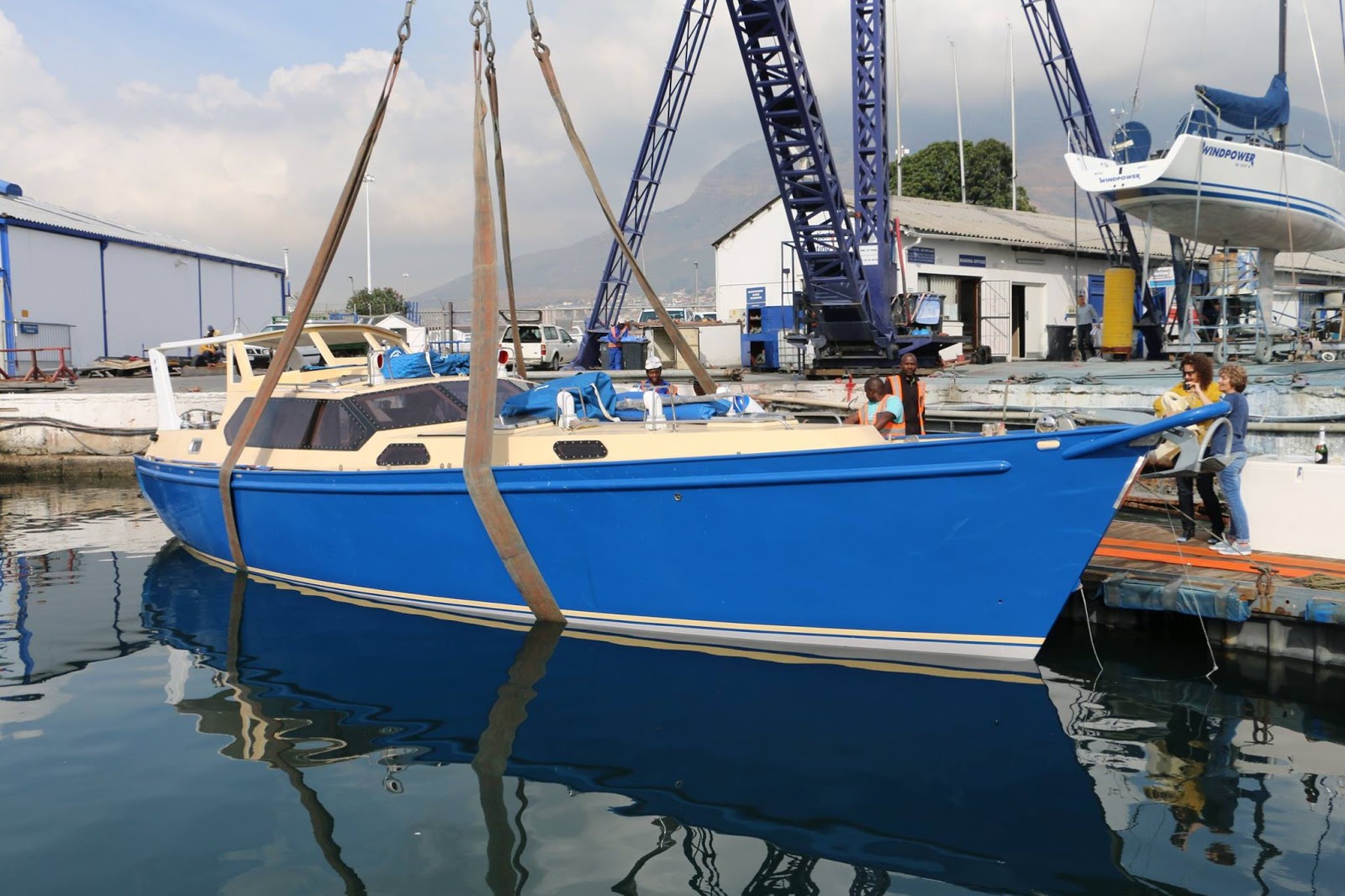
Andre Siebert built his boat in Gauteng, South Africa, then had her trucked 1000 miles to Cape Town for launch. I have a few more photos of Andre's boat than Ian's, so apologies to Ian for showing more of Andre's boat.
Congratulation to Ian and Andre for their impressive projects. We wish you happy cruising.
To see more of this and our other designs, go to our main website or our mobile website.
I think that this was due to a combination of causes, mostly related to the state of the world economy squeezing disposable income. Fewer people able to afford spending years cruising the oceans of the world has changed cruising dreams to smaller boats of their own for coastal or trailer-sailer cruising, or chartering bigger boats for a week or two at a time from others in the islands.
That may be changing though, we have recently seen an increasing interest in our more serious cruising designs, including those of steel. There still remains the problem of a dearth of professional yards that will build in steel but it does seem that the interest in steel boats may be returning.
The past few weeks have brought two new launches of steel sailboats to our Dix 43 Pilot design. These two were built many thousands of mile apart, in different hemispheres.
Ian Edwards built his boat in Caernarfon, Wales. A 10-year project, she is now in the water and ready to start cruising.
![]() |
| Ian Edwards built his boat in Caernarfon, Wales |
| Ian turning his hull using the spit-roast method. |
![]() |
| Andre's boat about to hit the highway from Gauteng to the ocean. |
![]() |
| Andre Siebert's launch of "Sea Bird" at Royal Cape Yacht Club, Cape Town. |
![]() |
| Beautifully finished pilothouse of "Sea Bird". |
![]() |
| "Sea Bird" with her rig stepped. |
To see more of this and our other designs, go to our main website or our mobile website.
Thursday, May 20, 2010
The tale of "Vlakvark", a very cold warthog
"Vlakvark" is a steel Vickers 45AC . She is named for an African warthog but she has spent much of her time in the past two years in the Antarctic. Owned by Stuart Sugden and Charmaine Lingard, this beautiful photo of her appeared last week as Cruising Shot of the Week in Cruising Compass, The Weekly Newsletter for Sailors & Cruisers.
"Vlakvark" was originally named "Tantalus". She was built by Brian Alcock and his team at Hout Bay Yachts, for John and Rose Stockwell. They cruised her across the Atlantic and chartered her for a few years in the Caribbean.
Her next owner renamed her "Sweetwater". She was based on the East Coast and cruised the Caribbean.
That owner sold her to Stuart and Charmaine, from British Columbia, who renamed her "Vlakvark". They wanted a connection to her South African origins, so chose the Afrikaans name for the warthog. They then took their warthog out of its normal hot climate and headed through the worst cruising waters in the world, to the ice. They have done this not once but twice. It seems that she has enjoyed the change and has carried her crew in comfort and safety. Now she is en-route North through the Pacific, heading for her home base in BC, Canada.
Dudley
Dudley
Subscribe to:
Posts (Atom)